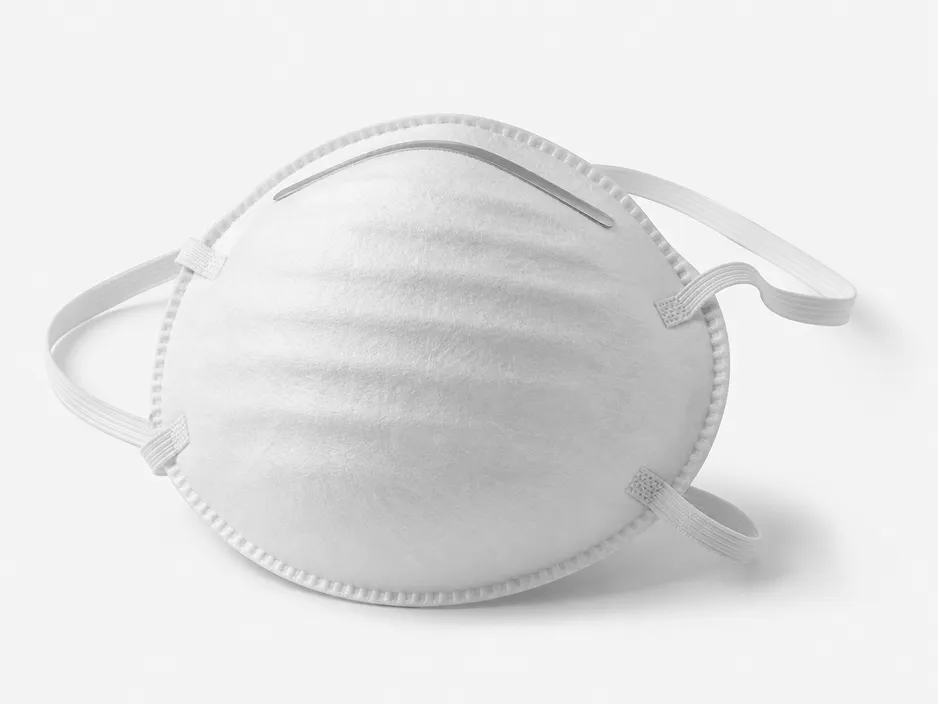
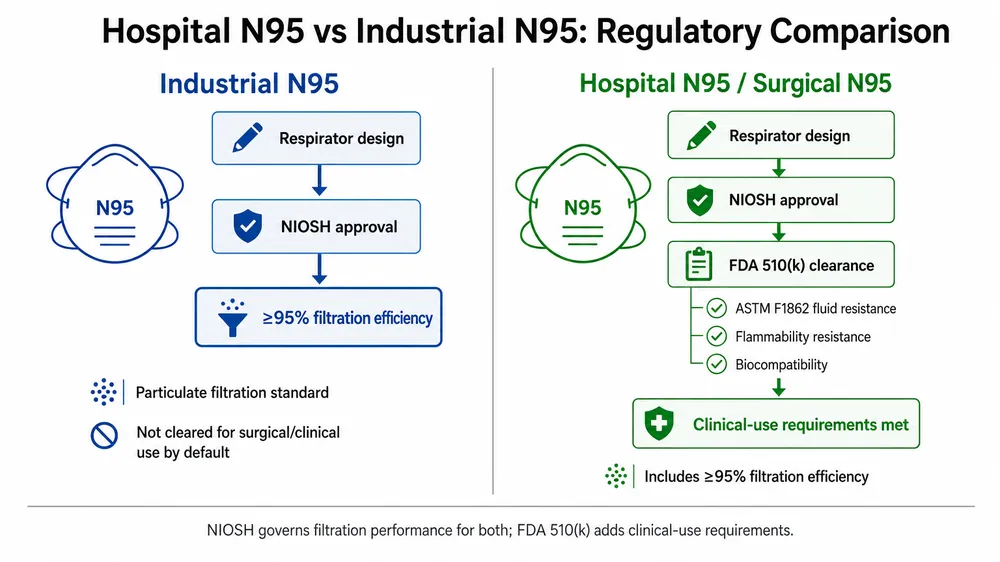
The N95 designation on a respirator tells you one thing: the filtration layer captures at least 95% of airborne particles at 0.3 microns. It does not tell you whether that respirator is cleared for use in a surgical or clinical environment. That distinction lives in a second layer of regulatory approval that most industrial N95 masks never go through — and that gap is exactly where hospital procurement decisions go wrong.
Here is the short version: an industrial N95 is NIOSH-approved for occupational respiratory protection. A hospital-grade N95 — also called a surgical N95 respirator — carries both NIOSH approval and FDA 510(k) clearance as a medical device. The FDA clearance adds requirements that industrial N95s are not tested against: fluid resistance to blood and body fluids (ASTM F1862), flammability resistance, and biocompatibility. If your supply chain is stocking clinical environments with NIOSH-only N95s, you are not meeting the regulatory standard for hospital use, and your procurement documentation will not survive an institutional audit.
The rest of this article explains the regulatory mechanism, the compliance exposure, and what to require from a supplier before you place an order.

The Regulatory Gap That Creates Procurement Liability
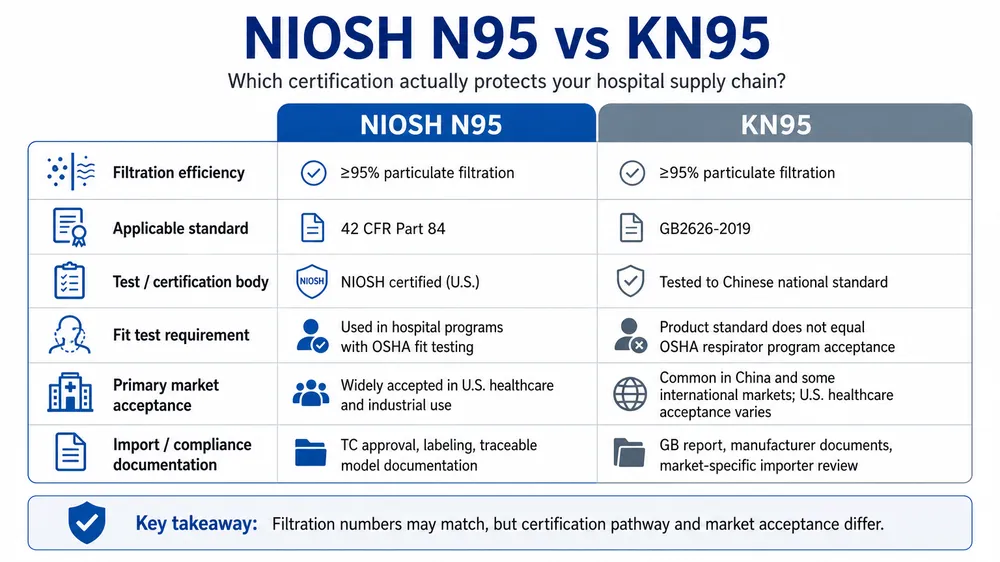
NIOSH — the National Institute for Occupational Safety and Health — tests and approves N95 respirators under 42 CFR Part 84. That standard covers filtration efficiency, breathing resistance, and fit. It was designed for occupational safety: construction workers, miners, industrial environments where airborne particulates are the hazard.
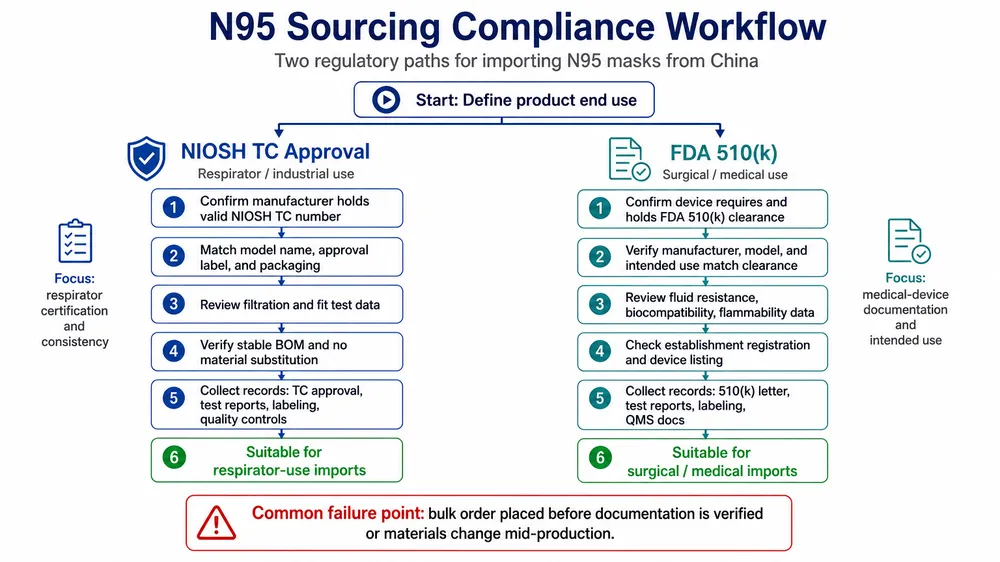
The FDA regulates medical devices under 21 CFR. A surgical N95 respirator is classified as a Class II medical device, which means it requires 510(k) clearance before it can be marketed for use in surgical or clinical settings. The 510(k) process requires the manufacturer to demonstrate that the product is substantially equivalent to a legally marketed predicate device — and that it meets additional performance requirements that NIOSH approval does not cover.
The two requirements that matter most for hospital procurement:
ASTM F1862 — Fluid Resistance. Surgical N95s must resist penetration by synthetic blood at a specified pressure (80 mmHg for Level 1, 120 mmHg for Level 2, 160 mmHg for Level 3). Industrial N95s are not tested against this standard. In a surgical or procedural environment where blood and body fluid splash is a realistic exposure, an industrial N95 provides no validated protection against fluid penetration.
Biocompatibility. FDA-cleared surgical N95s must meet biocompatibility requirements under ISO 10993 — the materials in contact with skin and mucous membranes are evaluated for cytotoxicity, sensitization, and irritation. Industrial N95s are not required to meet this standard.
The practical consequence: if a hospital or healthcare facility uses industrial N95s in clinical settings and that decision is reviewed during a Joint Commission survey, a CMS audit, or an internal compliance review, the facility cannot demonstrate that the respirators meet the FDA's standard for surgical or clinical use. The liability sits with the procurement decision, not with the mask manufacturer.
(We've had buyers come to us after exactly this situation — they sourced NIOSH-approved N95s from a supplier who didn't disclose that the product lacked FDA 510(k) clearance. The masks performed fine on filtration. They failed the procurement audit because the documentation didn't exist.)
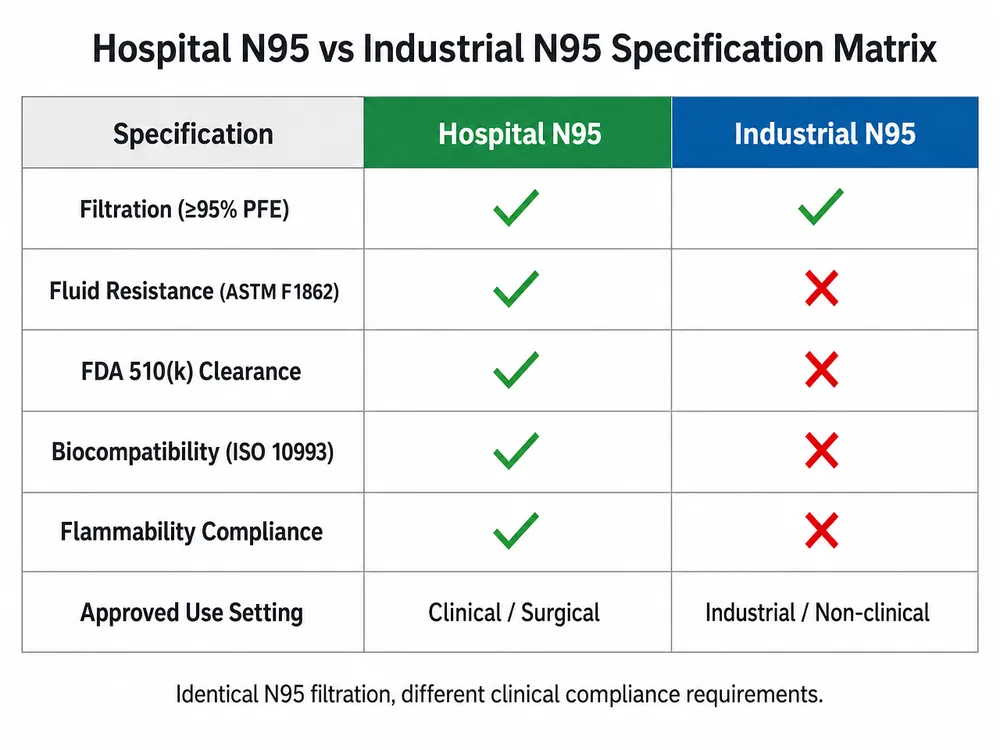
Head-to-Head: Hospital N95 vs Industrial N95 Specification Matrix
| Dimension | Hospital N95 (Surgical N95) | Industrial N95 |
|---|---|---|
| Filtration standard | NIOSH 42 CFR Part 84 (≥95% PFE) | NIOSH 42 CFR Part 84 (≥95% PFE) |
| Fluid resistance | ASTM F1862 required (synthetic blood splash) | Not required |
| FDA clearance | FDA 510(k) clearance required | Not required |
| Regulatory classification | Class II medical device (FDA) + NIOSH-approved respirator | NIOSH-approved respirator only |
| Biocompatibility | ISO 10993 evaluation required | Not required |
| Flammability | 16 CFR Part 1610 compliance required | Not required |
| Approved use setting | Surgical suites, clinical environments, patient care | Occupational/industrial environments |
| Procurement channel | Hospital supply chain, medical device distributors | Industrial safety distributors, construction supply |
| Import documentation | FDA 510(k) number required for US import as medical device | NIOSH approval number sufficient |
| EU equivalent | EN 149 + EN 14683 (surgical respirator) | EN 149 only |
The filtration row is identical — both types filter at ≥95% PFE. Everything below it is where the hospital-grade product carries requirements the industrial version was never designed to meet.
The Hidden Procurement Cost of Getting This Wrong
The price difference between a NIOSH-only industrial N95 and an FDA-cleared surgical N95 is real — hospital-grade product typically costs more because the manufacturer carries the additional regulatory burden of maintaining FDA 510(k) registration, running fluid resistance testing, and operating under a medical device QMS (ISO 13485). Buyers who optimize on unit price without understanding this distinction are not saving money. They are shifting compliance risk onto their own organization.
The downstream costs of substituting industrial N95 in clinical settings:
Audit exposure. Hospital procurement is subject to review by accreditation bodies, government payers, and internal compliance teams. A supply chain that cannot produce FDA 510(k) documentation for its N95 respirators is a finding — and findings have remediation costs that dwarf the per-unit price difference.
Liability in adverse events. If a healthcare worker is exposed to a blood-borne pathogen while wearing an industrial N95 that was not rated for fluid resistance, the absence of FDA clearance becomes a material fact in any subsequent liability analysis. The procurement record showing that a non-cleared product was used in a clinical setting is not a position you want to defend.
Import documentation failure. When sourcing from overseas manufacturers, the FDA 510(k) registration number is required for US Customs clearance of medical devices. An industrial N95 imported without this documentation may clear customs under a different HTS code — but it cannot be sold or distributed as a medical device in the US. Buyers who discover this after the shipment arrives face either re-export or destruction of the inventory.
Batch inconsistency risk. Industrial N95 manufacturers are not required to operate under ISO 13485 quality management systems. The QC discipline that ensures consistent BFE and PFE performance across production batches is a medical device manufacturing requirement, not an occupational safety one. Sourcing hospital-grade N95 from a manufacturer without ISO 13485 certification means you are accepting batch-to-batch variability that a hospital procurement audit will flag.
Application Scenarios: When Each Grade Is the Right Call
Scenario 1: Hospital and Surgical Environment Procurement
Winner: Hospital N95 (Surgical N95) — no exception.
Any N95 procurement for use in surgical suites, procedure rooms, emergency departments, or patient-facing clinical roles requires FDA 510(k)-cleared product. This is not a gray area. The Joint Commission's infection control standards, CMS Conditions of Participation, and OSHA's respiratory protection standard for healthcare all point to the same requirement: respirators used in clinical settings where blood and body fluid exposure is possible must meet the fluid resistance standard. An industrial N95 does not.
If your tender or GPO contract specifies "N95 respirator for clinical use," the correct product is a surgical N95 with a valid FDA 510(k) number. Sourcing industrial N95 against that specification is a non-conformance.
Scenario 2: Non-Clinical Healthcare Settings — Administrative, Logistics, Environmental Services
Winner: Industrial N95 is acceptable in most cases, with caveats.
Healthcare workers in roles with no direct patient contact and no exposure to blood or body fluids — administrative staff, supply chain personnel, environmental services in non-clinical zones — can typically use NIOSH-approved industrial N95s for airborne infection control purposes. The fluid resistance requirement is not triggered when the exposure scenario doesn't involve blood splash.
The caveat: check your facility's infection control policy. Some hospital systems standardize on surgical N95 across all staff categories to simplify procurement and eliminate the risk of wrong-product deployment. If your facility has that policy, the unit cost difference is the price of operational simplicity — and it's usually worth it.
Scenario 3: Emergency Stockpile and Surge Capacity Procurement
Winner: Hospital N95 for any stockpile intended for clinical deployment.
Surge stockpiles built for pandemic response or mass casualty events are eventually deployed in clinical settings. Stocking industrial N95 in a surge cache that will be issued to clinical staff during an emergency creates the same compliance exposure as routine clinical procurement — it just surfaces under worse conditions. The FDA's emergency use authorization (EUA) framework has historically allowed some flexibility during declared public health emergencies, but EUA status is not guaranteed and cannot be planned around. Build your stockpile to the standard that applies in normal operations.
(We've supplied surge stockpile orders to hospital networks in the Middle East and Southeast Asia. The buyers who specified surgical N95 from the start had no documentation problems when the product was deployed. The buyers who mixed grades had to sort inventory under pressure.)
Supplier Qualification: What Documentation to Require Before You Order
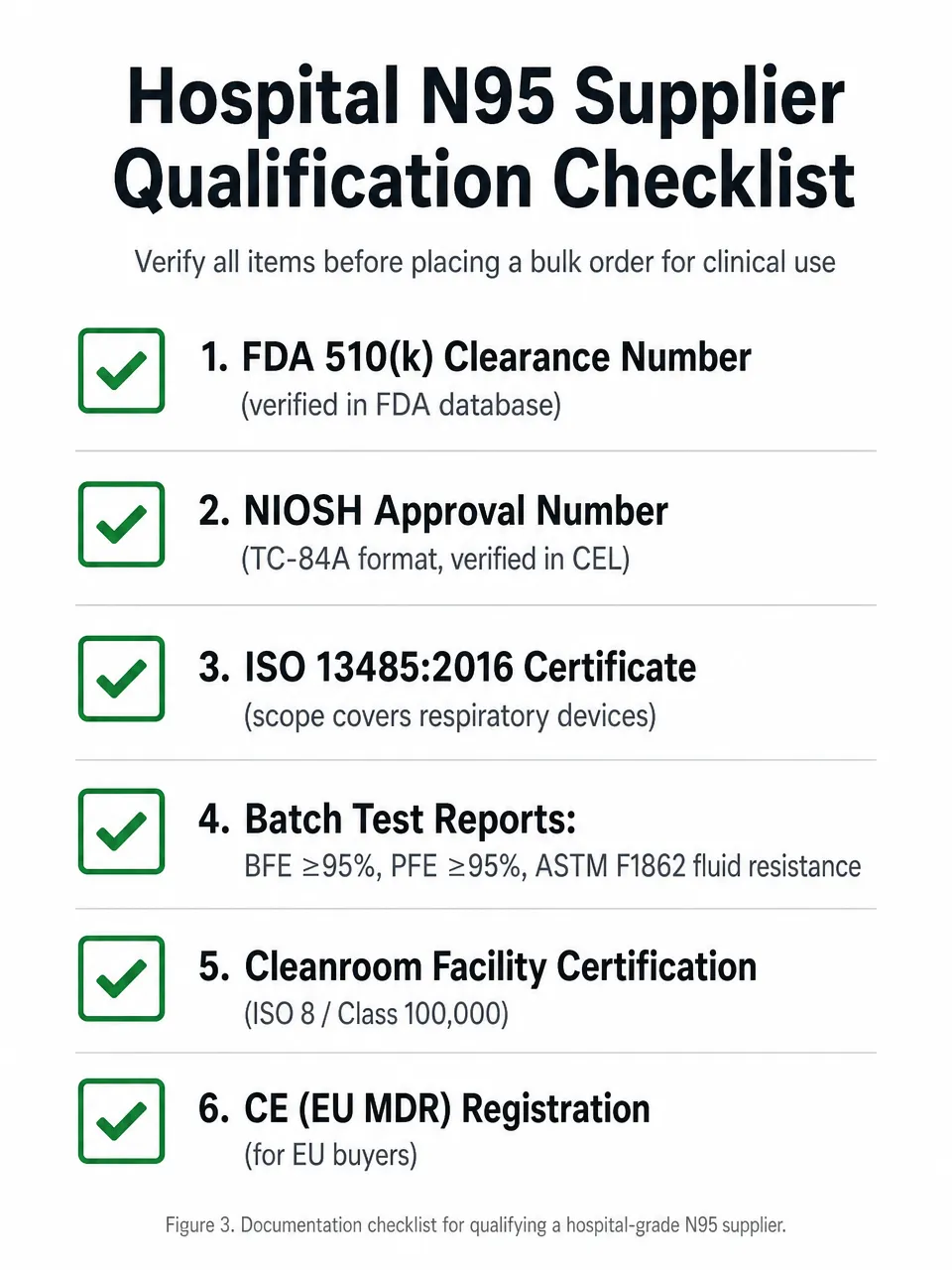
The regulatory distinction between hospital N95 and industrial N95 is only as useful as your ability to verify it in a supplier's documentation. Here is what to require before placing an order for hospital-grade N95:
1. FDA 510(k) Clearance Number Request the 510(k) number and verify it in the FDA's 510(k) database (accessible at fda.gov). The clearance should be for a surgical N95 respirator, not a surgical mask or a non-surgical respirator. Confirm the cleared product name matches what you are ordering.
2. NIOSH Approval Number The NIOSH approval number (TC-84A-XXXX format) confirms the respirator meets 42 CFR Part 84 filtration requirements. Verify it in the NIOSH Certified Equipment List. Both the NIOSH approval and the FDA 510(k) must be present for a legitimate hospital-grade N95.
3. ISO 13485:2016 Certificate This is the medical device quality management system standard. A manufacturer without ISO 13485 certification is not operating under the QMS discipline required for consistent medical device production. Request the certificate and check the scope — it should cover disposable respiratory protective devices or equivalent.
4. Batch Test Reports — BFE, PFE, and Fluid Resistance Request test reports from the specific production batch you are ordering, not generic product-level certificates. The reports should show BFE (≥95%), PFE (≥95%), Delta-P (breathability), and ASTM F1862 fluid resistance results. If the supplier cannot provide batch-level test reports, their QC process is not running at the level required for hospital procurement.
5. Facility Certification — Cleanroom Manufacturing Hospital-grade N95 production should occur in a controlled manufacturing environment. ISO 13485 requires documented environmental controls; a Class 100,000 (ISO 8) cleanroom is the standard for medical mask production. Ask for the facility certification or audit report.
6. CE (EU MDR) Registration (for European buyers) If you are supplying EU hospitals, the product must carry CE marking under EU MDR (Regulation 2017/745) as a medical device, in addition to EN 149 respirator certification. These are separate requirements — EN 149 alone is not sufficient for clinical use in the EU.
How eztio Meets the Dual-Clearance Requirement
We hold FDA 510(k) registration alongside our NIOSH-equivalent certifications, ISO 13485:2016, and CE under EU MDR. That combination is what hospital procurement actually requires — not just filtration performance, but the full regulatory stack that allows the product to enter clinical supply chains in the US and EU without documentation gaps.
The filtration layer is where most of the performance risk lives, and we control it directly. We produce our own meltblown nonwoven fabric in-house — the fiber diameter, basis weight, and electrostatic charge are set to our spec, not a third-party supplier's. When we report ≥95% BFE and PFE on a batch, those numbers come from our in-house QC lab running tests on material we made, not material we received and hoped was correct. For hospital procurement audits that require batch-level test reports, this matters: we can produce them because we run the tests, not because we're forwarding a supplier's certificate.
Our production runs in a Class 100,000 (ISO 8) cleanroom — continuous particle monitoring, controlled access, documented environmental records. ISO 13485:2016 governs the entire QMS: incoming material inspection, in-process controls, outgoing batch testing, and the traceability documentation that connects every shipped unit back to its production batch and raw material lot. When your compliance team or a third-party auditor reviews the documentation package, the chain of custody is complete.
The CE (EU MDR) registration alongside FDA clearance means a single source can supply both US and European hospital buyers without product substitution. We've shipped to hospital networks and healthcare distributors across North America, Europe, the Middle East, and Southeast Asia — the documentation requirements differ by market, and our export team prepares the full package for each destination.
For buyers sourcing Hospital N95 Medical Masks for institutional procurement, the relevant certifications and audit documentation are available on request before you place an order. We don't send a certificate PDF and call it done — if your compliance team needs to review the full technical file or the ISO 13485 audit report, we make that available. (This is standard practice for hospital supply chain qualification, and we've been through it enough times that the process is straightforward on our end.)
Sourcing Decision Framework: Structuring Your RFQ for the Right Grade
When you send an RFQ for N95 respirators to an overseas manufacturer, the product description needs to specify the regulatory grade — not just the filtration rating. "N95 respirator, ≥95% filtration" describes both hospital-grade and industrial-grade product. The supplier will quote whichever version they manufacture, and if they don't hold FDA 510(k) clearance, they may not volunteer that information.
Structure your RFQ to include:
- Product designation: Surgical N95 respirator (FDA 510(k)-cleared) or industrial N95 respirator (NIOSH-approved only) — specify which
- Applicable standards: NIOSH 42 CFR Part 84 + FDA 510(k) for hospital grade; NIOSH 42 CFR Part 84 only for industrial
- Fluid resistance requirement: ASTM F1862 Level 1/2/3 — specify the level required for your application
- Destination market: US, EU, or other — this determines which regulatory documentation the supplier must provide
- Required documentation: List the specific documents you need (510(k) number, NIOSH approval, ISO 13485 certificate, batch test reports, CE certificate)
- Order volume and delivery schedule: Affects MOQ qualification and production scheduling
A supplier who cannot respond to each of these points with specific documentation is not qualified for hospital procurement, regardless of their unit price.
For buyers managing N95 Medical Masks procurement across multiple markets, the documentation requirements for US and EU import differ enough that it's worth confirming with your supplier before the order is placed — not after the shipment arrives. Our export team has handled FDA import records, CE technical files, and Gulf state SFDA equivalents, and we can walk you through what your customs broker or compliance team will need for your specific destination.
For a full overview of our certifications and compliance documentation, including our FDA 510(k) registration details and ISO 13485 certificate scope, those are available on request.
Frequently Asked Questions
Can an industrial N95 be used in a hospital setting?
For non-clinical roles with no blood or body fluid exposure risk — administrative staff, logistics, environmental services in non-patient areas — a NIOSH-approved industrial N95 is generally acceptable for airborne infection control. For any clinical role where blood splash or body fluid exposure is possible, the answer is no: FDA 510(k)-cleared surgical N95 is required. The fluid resistance requirement (ASTM F1862) is the line that industrial N95s do not cross.
What is the difference between a surgical N95 and a regular N95?
Both filter at ≥95% PFE. A surgical N95 additionally carries FDA 510(k) clearance as a medical device, which requires passing ASTM F1862 fluid resistance testing, biocompatibility evaluation under ISO 10993, and flammability compliance. A "regular" N95 — meaning NIOSH-approved only — meets none of those additional requirements. The filtration performance is equivalent; the clinical use authorization is not.
What FDA 510(k) clearance number should I look for when sourcing hospital N95?
The 510(k) number is in the format K followed by six digits (e.g., K123456). You can verify any 510(k) number in the FDA's 510(k) Premarket Notification database at fda.gov. The cleared device name should specify "surgical N95 respirator" — not surgical mask, not dust respirator, not KN95. If the supplier provides a 510(k) number that clears a different product type, it does not cover the surgical N95 you are ordering.
Does NIOSH approval from a Chinese manufacturer qualify for US hospital procurement?
NIOSH approval is issued by the US CDC/NIOSH and requires the manufacturer to submit product samples and documentation for testing at NIOSH-approved labs. A Chinese manufacturer can hold a valid NIOSH approval number — the approval is product-specific, not geography-restricted. However, NIOSH approval alone is not sufficient for hospital use. The product must also hold FDA 510(k) clearance. Verify both numbers independently before placing an order.
What is the minimum order quantity for hospital-grade N95 from eztio?
Our standard MOQ for N95 respirators is 50,000 pieces for standard SKUs. For hospital-grade surgical N95 with specific fluid resistance levels or custom OEM packaging, the MOQ may be higher depending on configuration — we'll confirm the exact figure when you send your RFQ with product specifications and destination market.
How do I verify that batch test reports from a Chinese manufacturer are legitimate?
Request reports from an accredited third-party laboratory — SGS, Intertek, Bureau Veritas, or a NIOSH-recognized testing facility. In-house test reports from the manufacturer are useful for ongoing QC monitoring but should be supplemented by third-party certification for initial supplier qualification. Ask for the lab's accreditation certificate alongside the test report. At eztio, we run in-house BFE/PFE/Delta-P testing on every production batch and submit to third-party labs for certification documentation — both sets of reports are available for your compliance review.