Infection control auditors don't fail a surgical cap because it looks wrong. They fail it because the fabric sheds particles under movement, or because the elastic gaps at the nape when a scrub tech leans forward, or because the lot documentation your supplier sent doesn't match the GSM spec on the product label. These are the failure modes that actually show up in OR compliance reviews — and none of them are visible from a product photo or a distributor's spec sheet.
This article covers what hair containment standards actually require from a disposable surgical cap, how fabric weight and fit geometry translate into audit outcomes, and what to verify from a supplier before you commit to volume.
What the Standards Actually Specify — and What They Leave to You
The three frameworks that govern OR hair containment in most markets are AORN (Association of periOperative Registered Nurses), AAMI (Association for the Advancement of Medical Instrumentation), and EN 13795 for European markets. None of them specify a minimum GSM for surgical cap nonwoven fabric. That's worth stating plainly, because a lot of sourcing conversations get stuck on the wrong question.
What these standards do specify — or strongly recommend — is the outcome: all hair, including facial hair and sideburns, must be fully contained during the surgical procedure. AORN's guidelines require that caps cover the hair and ears completely, with no loose strands visible. EN 13795 addresses surgical drapes and gowns more than caps specifically, but its contamination control framework informs how hospital infection control committees evaluate any OR textile.
The gap between "outcome specified" and "material not specified" is where your sourcing decision lives. Your infection control committee will interpret the standard and set a facility policy. That policy may specify cap style (bouffant vs. tie-back), coverage area, or even brand. What it almost never specifies is the nonwoven GSM — which means the GSM decision falls to whoever is sourcing the caps.
Get that decision wrong and you'll find out during an audit, not before.
Why Fabric Weight Determines Whether a Cap Passes or Fails Under Movement
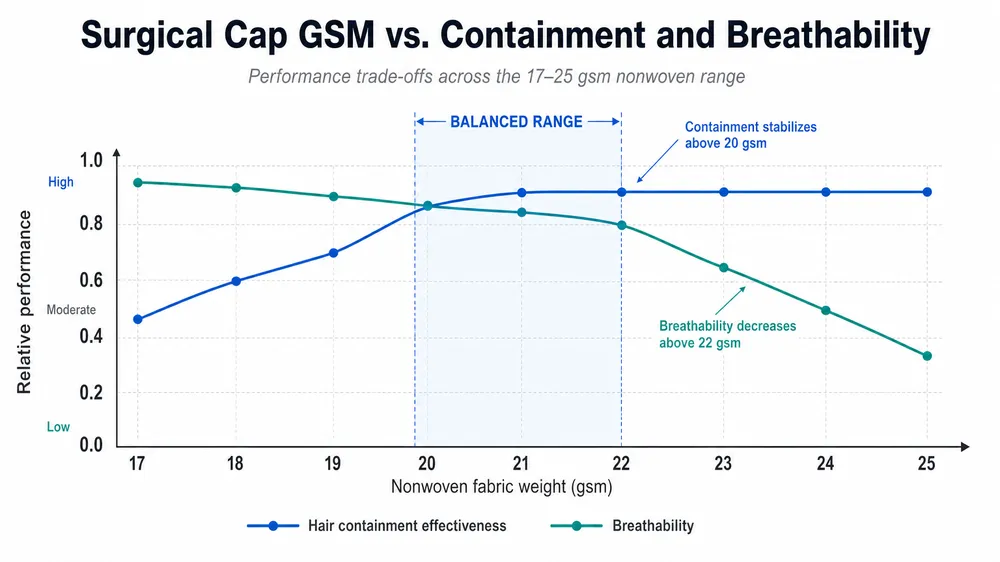
The GSM range for disposable surgical cap nonwoven runs from roughly 17 gsm at the light end to 25 gsm for heavier clinical-grade product. That 8-gram spread sounds narrow. The performance difference is not.
At 17–18 gsm, polypropylene spunbond nonwoven is thin enough that it flexes and deforms under normal head movement. The fiber structure is less dense, which means two things happen simultaneously: the fabric is more likely to shed fibers itself (adding particulate to the OR environment rather than containing it), and it provides less resistance to hair penetration when the wearer moves, bends, or turns their head. A cap that contains hair perfectly when the wearer is standing still may allow fine hair strands to work through the fabric during a two-hour procedure.
At 20–22 gsm, the fiber density is high enough to maintain structural integrity under movement. The fabric holds its shape, the pore structure stays consistent, and the containment barrier remains intact across the full procedure duration. This is the range we run our standard surgical cap line at — not because 20 gsm is a magic number, but because it's where the performance curve stabilizes for typical OR use.
(We've tested lighter fabric at buyer request. The 17 gsm product passes initial visual inspection and feels fine in a sample evaluation. The problem shows up in extended wear testing, where the fabric deforms at the crown and the containment geometry changes. We stopped offering it as a standard option.)
At 25 gsm, you get additional durability and a more opaque appearance, which some buyers prefer for aesthetic reasons. The containment performance is comparable to 22 gsm for most applications. The trade-off is breathability — heavier fabric runs warmer, which matters in long procedures. Most of our OR-focused buyers land on 20–22 gsm as the practical optimum.

The audit implication: if your supplier cannot tell you the GSM of the nonwoven they're using, or if the spec sheet says "17–25 gsm" as a range rather than a controlled target, that's a sourcing problem. A range that wide means the fabric weight can vary batch to batch, and your compliance performance varies with it.
Tie-Back vs. Elastic: How Fit Geometry Affects Coverage Consistency
Fabric weight handles the containment barrier. Fit geometry determines whether that barrier actually covers what it needs to cover — consistently, across the full range of head sizes in your OR staff population.
The two dominant configurations are tie-back (also called surgeon's cap or scrub cap style) and elastic bouffant. They solve the coverage problem differently, and each has a failure mode that matters for compliance.
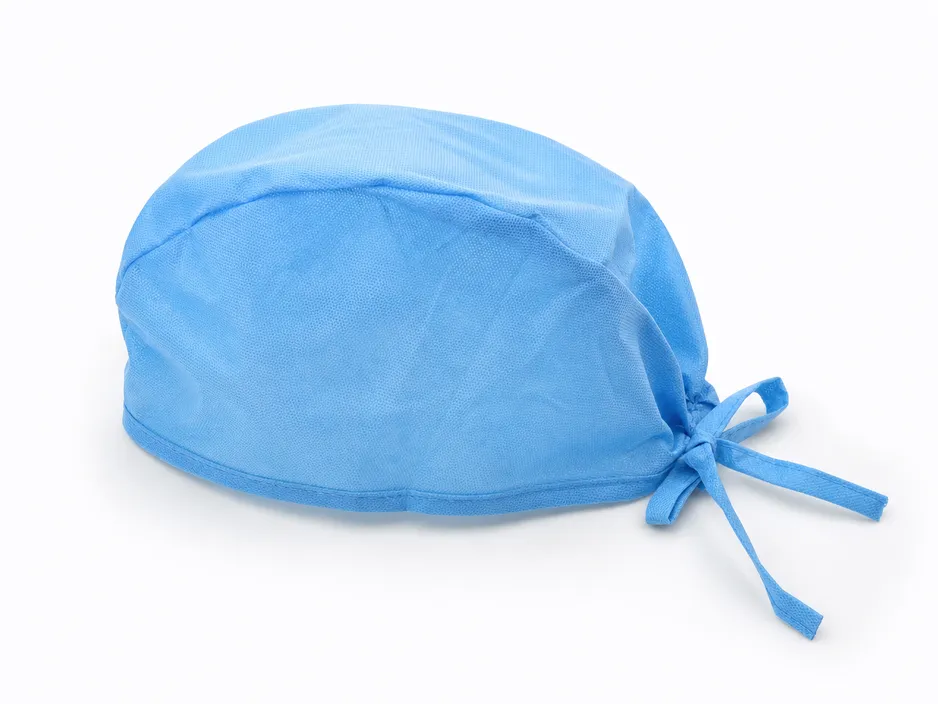
Tie-back caps use fabric ties that the wearer adjusts manually. The coverage area is determined by how the wearer ties the cap, which means it's variable. A properly tied tie-back cap provides excellent coverage and a secure fit that doesn't shift during a procedure. An improperly tied one — too loose at the nape, or with the front edge sitting too high on the forehead — creates containment gaps that are visible to an auditor. The failure mode is user technique, not the cap itself.
For compliance purposes, tie-back caps require staff training and periodic observation to ensure consistent technique. Facilities that use them typically include cap-tying technique in their OR orientation protocol. If yours doesn't, the cap spec is only half the solution.
Elastic bouffant caps remove the technique variable. The elastic band creates a defined coverage perimeter that doesn't depend on how the wearer adjusts it. The failure mode here is elastic specification: if the elastic is too loose, the band gaps at the nape or temples when the wearer moves. If it's too tight, staff will fold the band back or wear the cap incorrectly to relieve pressure — which defeats the containment geometry entirely.
The elastic spec we use for our standard bouffant line is 0.6 cm flat elastic with a finished circumference of 56–60 cm, which covers the 5th–95th percentile adult head size range without requiring adjustment. (We've had buyers request tighter elastic for a "more secure" feel. We push back on that — elastic that's uncomfortable gets modified by the wearer, and a modified cap is a non-compliant cap.)
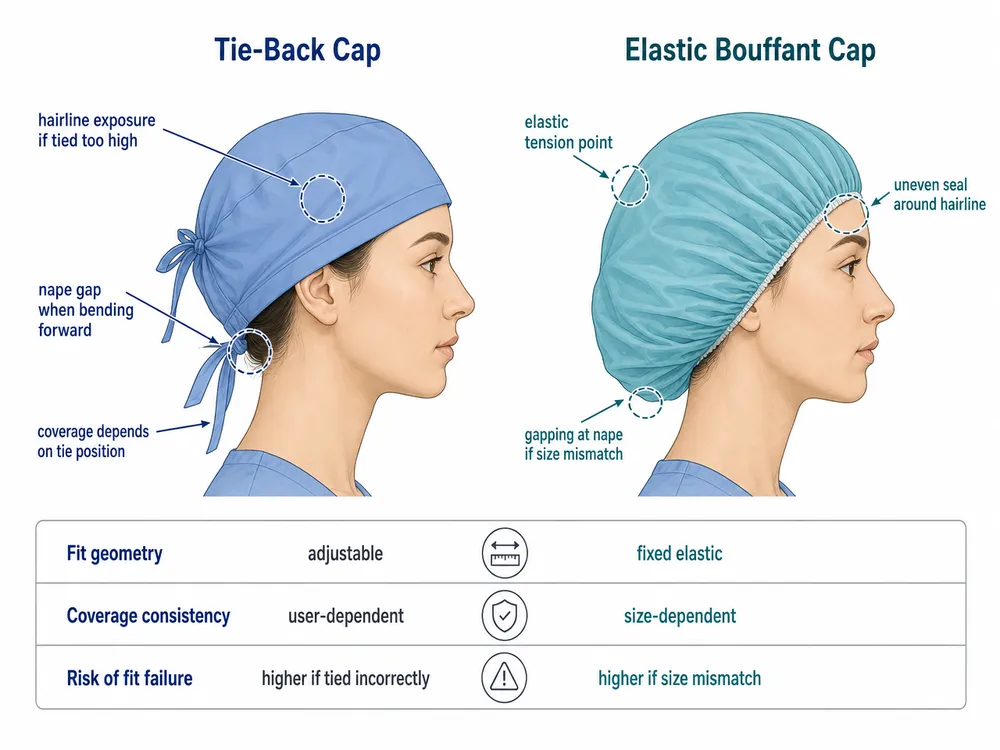
For volume sourcing, the practical question is which configuration your facility's infection control policy specifies, and whether your supplier can hold the elastic spec consistently across batches. A bouffant cap where the elastic circumference drifts from 56 cm to 62 cm between lots is functionally a different product — and the coverage gap it creates is the kind of thing that shows up in an audit observation, not a product test.
What Auditors Actually Look For During OR Compliance Reviews
Infection control auditors evaluating surgical cap compliance are looking at three things: coverage, containment, and documentation.
Coverage is the visual check. Is all hair — including sideburns, nape hair, and any hair visible at the forehead — fully enclosed by the cap? This is where fit geometry matters most. A cap that covers 95% of the head but gaps at the nape on staff with longer hair will generate an observation. Auditors typically observe staff during actual procedures, not just during pre-op preparation, because coverage that looks adequate at the scrub sink may shift during a two-hour case.
Containment is harder to assess visually and is usually evaluated through the facility's broader contamination control data — surgical site infection rates, particle count monitoring in the OR, and any incident reports related to foreign body contamination. A cap that sheds fibers contributes to this data over time. This is where fabric quality matters beyond what any single audit observation can catch.
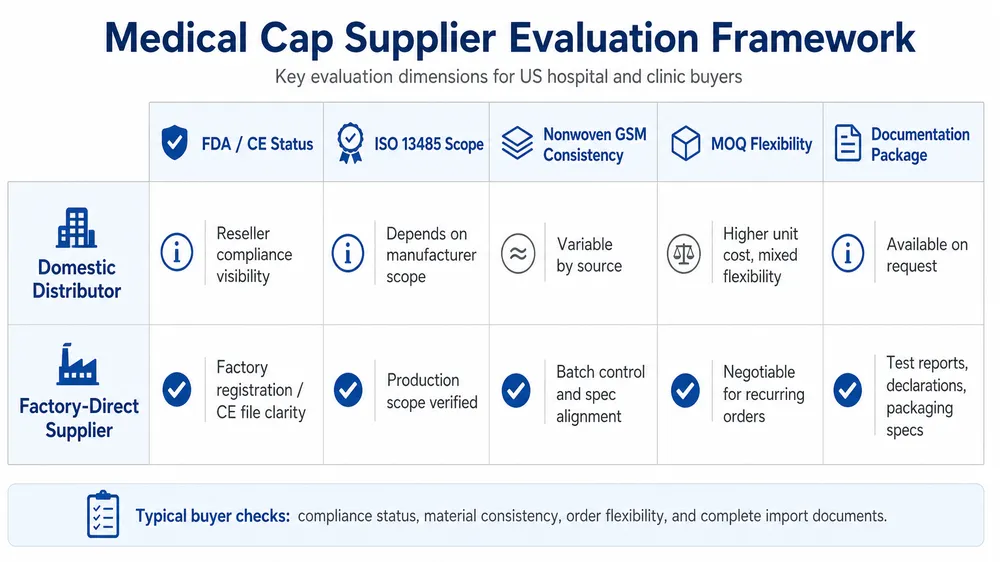
Documentation is where sourcing decisions become compliance decisions. When an infection control committee reviews the caps in use, they may request product specifications, test reports, or certification documentation. If your supplier is a distributor who sources from multiple factories, the documentation they can provide is limited to what those factories share with them — which is often a product data sheet and a CE certificate, nothing more.
A manufacturer with ISO 13485 QMS can provide lot-level traceability: which nonwoven roll was used in which production batch, what the incoming inspection results were for that roll, and what the outgoing QC results were for the finished caps. That documentation chain is what survives a serious compliance review. Distributors generally cannot provide it because they don't have it.
Our Surgical Medical Cap line is produced under ISO 13485:2016 QMS, which means every production lot has a documented material record — nonwoven GSM verification, elastic tensile test results, and finished cap dimensional inspection. When your infection control committee asks for documentation, we can provide the actual production records, not just the product label.
The Sourcing Trap: What "Certified" Doesn't Tell You
Most surgical cap suppliers will show you a CE certificate or an ISO 13485 certificate. These are necessary but not sufficient for compliance-sensitive procurement. Here's what those documents don't tell you:
A CE certificate confirms that the product was tested and met the standard at the time of certification. It doesn't confirm that the product you receive today was made to the same spec as the product that was tested. If the supplier changed their nonwoven source, adjusted the GSM to reduce cost, or switched elastic suppliers between certification and your order, the certificate is still valid — but the product may not perform the same way.
ISO 13485 certification confirms that the manufacturer has a quality management system in place. It doesn't confirm that the specific product you're ordering was manufactured under that system, or that the factory actually follows the documented procedures. Surveillance audits happen annually; a lot of production happens between audits.
What actually protects you is lot-level documentation: incoming material test records, in-process inspection data, and outgoing QC results tied to the specific lot number on your shipment. This is what ISO 13485 is designed to produce — but only if the factory is actually running the system, not just holding the certificate.
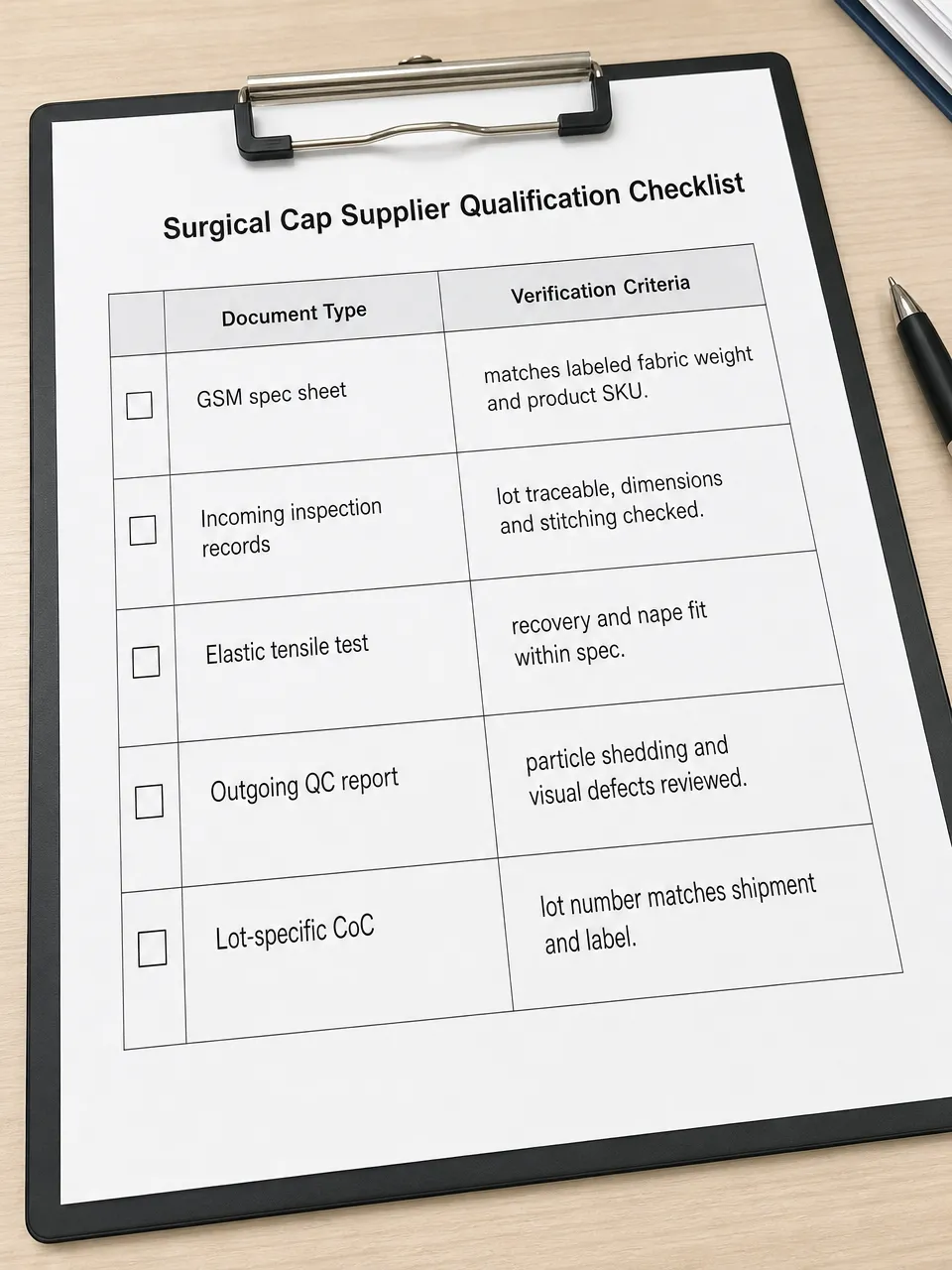
When you're qualifying a surgical cap supplier for compliance-sensitive procurement, ask for:
- Nonwoven GSM specification with acceptable tolerance range (e.g., 20 gsm ± 1 gsm)
- Incoming inspection records for nonwoven fabric (basis weight test per lot)
- Elastic tensile test results and finished cap circumference measurement records
- Outgoing QC inspection report for a recent production lot
- Certificate of conformity tied to a specific lot number, not just the product model
If a supplier cannot provide these documents, they are selling you a product, not a documented supply chain. For routine procurement, that may be acceptable. For compliance-sensitive OR procurement where your infection control committee can ask for documentation at any time, it's a risk.
We've seen buyers switch suppliers after an audit observation — not because the caps failed, but because they couldn't produce the documentation the auditor requested. The caps were probably fine. The paper trail wasn't there.
Spec Consistency Across Batches: The Volume Sourcing Problem
Single-order compliance is a lower bar than multi-order consistency. A supplier can produce a compliant lot for your initial order and drift on subsequent lots — different nonwoven roll, slightly different elastic tension, minor dimensional variation in the cap body. Each individual lot might pass a spot check. The cumulative drift across six months of orders is what creates a compliance exposure.
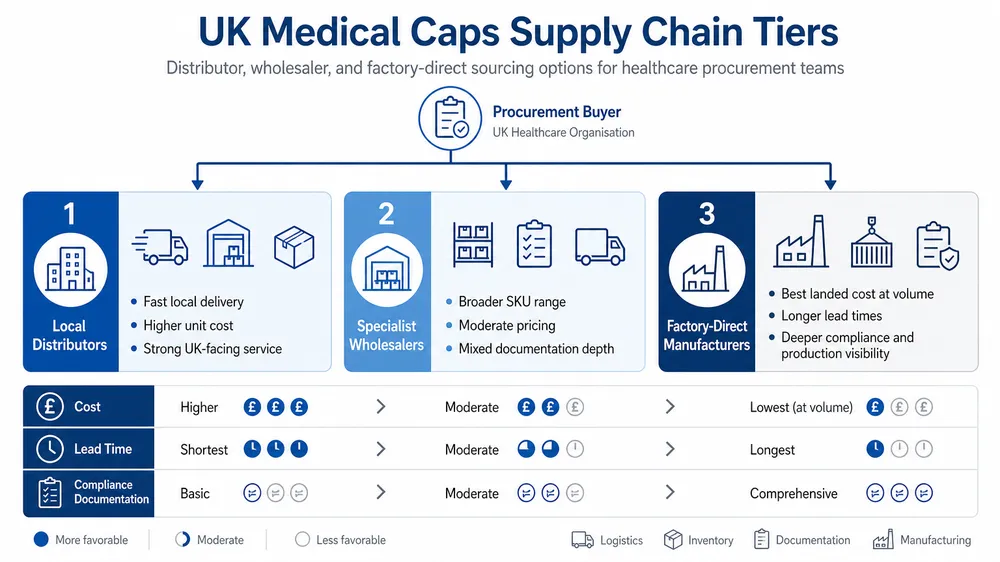
This is a structural problem with sourcing surgical caps from distributors or trading companies. They don't control production parameters. They place orders with factories, and those factories may substitute materials, adjust specs, or run the product on different lines depending on capacity. The distributor often doesn't know this happened until a buyer reports a problem.
We run our surgical cap line on dedicated production equipment with documented process parameters. The nonwoven GSM target, elastic tension setting, and cap body dimensions are locked in the production record for each SKU. When you reorder, you're reordering the same spec — not whatever the factory happens to be running that week.
For buyers managing Medical Caps procurement across multiple facilities or multiple order cycles, this consistency is the actual value proposition. A cap that passes your first compliance audit and then drifts on the third order is worse than a slightly more expensive cap that holds spec reliably.
Matching Cap Spec to Your Compliance Context
Not every OR environment has the same compliance pressure. Here's a practical framework for matching cap spec to your situation:
| Compliance Context | Recommended GSM | Fit Configuration | Documentation Priority |
|---|---|---|---|
| Acute care OR, active infection control audits | 20–22 gsm | Elastic bouffant, 56–60 cm circumference | Full lot traceability required |
| Ambulatory surgery center, periodic review | 20 gsm | Elastic bouffant or tie-back | CoC + GSM spec sheet sufficient |
| Procedure rooms, lower contamination risk | 18–20 gsm | Elastic bouffant | Standard product documentation |
| Private-label program for hospital distribution | 20–22 gsm | Elastic bouffant | Full documentation package for downstream buyers |
The 20 gsm threshold is where we draw the line for OR-specific procurement. Below that, the containment performance under movement is variable enough that we wouldn't recommend it for active surgical environments. Above 22 gsm, you're paying for durability and opacity that most OR applications don't require.
For private-label programs — where you're distributing caps to hospital buyers who will face their own compliance audits — the documentation requirement is actually higher than for direct procurement. Your downstream buyers need to be able to produce documentation for their auditors, which means you need to be able to produce it for them. A supplier who can't provide lot-level records puts your entire distribution program at risk when one of your hospital customers gets audited.
Frequently Asked Questions
What GSM is required for surgical cap hair containment compliance?
No standard specifies a minimum GSM directly. AORN, AAMI, and EN 13795 specify the outcome — complete hair containment — not the material. In practice, 20–22 gsm polypropylene spunbond nonwoven is the range that reliably maintains containment under OR movement conditions. Lighter fabric (17–18 gsm) may pass initial inspection but can deform and allow hair penetration during extended wear. If your infection control committee asks about fabric spec, 20 gsm is a defensible minimum with a clear performance rationale.
How does elastic specification affect surgical cap compliance?
Elastic that's too loose creates coverage gaps at the nape and temples when the wearer moves. Elastic that's too tight causes staff to modify the cap — folding the band, wearing it incorrectly — which defeats the containment geometry. The functional range for adult OR staff is a finished cap circumference of 56–60 cm with flat elastic of 0.6–0.8 cm width. Ask your supplier for elastic tensile test results and finished circumference measurements, not just a product description.
What documentation should I request from a surgical cap supplier before a compliance audit?
At minimum: a GSM specification with tolerance range, incoming nonwoven inspection records, elastic tensile test results, and a certificate of conformity tied to a specific lot number. For compliance-sensitive procurement, also request outgoing QC inspection reports for a recent production lot. A supplier who can only provide a CE certificate and a product data sheet cannot support your documentation requirements if an auditor asks for material traceability.
Can tie-back surgical caps meet the same compliance standard as elastic bouffant caps?
Yes, if worn correctly. The compliance risk with tie-back caps is technique variability — coverage depends on how the wearer ties the cap, not on a fixed elastic perimeter. Facilities using tie-back caps typically need to include cap-tying technique in OR orientation and conduct periodic observation to ensure consistent coverage. For high-volume OR environments where staff turnover is a factor, elastic bouffant caps reduce the technique variable and are easier to audit consistently.
What is the difference between a CE certificate and lot-level documentation for surgical caps?
A CE certificate confirms the product model was tested and met the standard at certification. It doesn't confirm that the specific lot you received was manufactured to the same spec. Lot-level documentation — incoming material records, in-process inspection data, outgoing QC results — confirms that the actual production batch you're using was made and tested to spec. For compliance-sensitive procurement, lot-level documentation is what protects you when an auditor asks for evidence, not just the product certificate.
If your procurement program requires lot-traceable surgical caps with documented GSM specs and full material records, our Surgical Medical Cap line is built for that requirement. You can also review our full Medical Caps range or read more about surgical cap tie-back design and fabric spec if you're evaluating both configurations.
For compliance-sensitive orders, send your required GSM, cap style, and volume to our team via Request Quote — we'll respond with a lot-specific documentation sample alongside the product quote so you can evaluate both before committing.