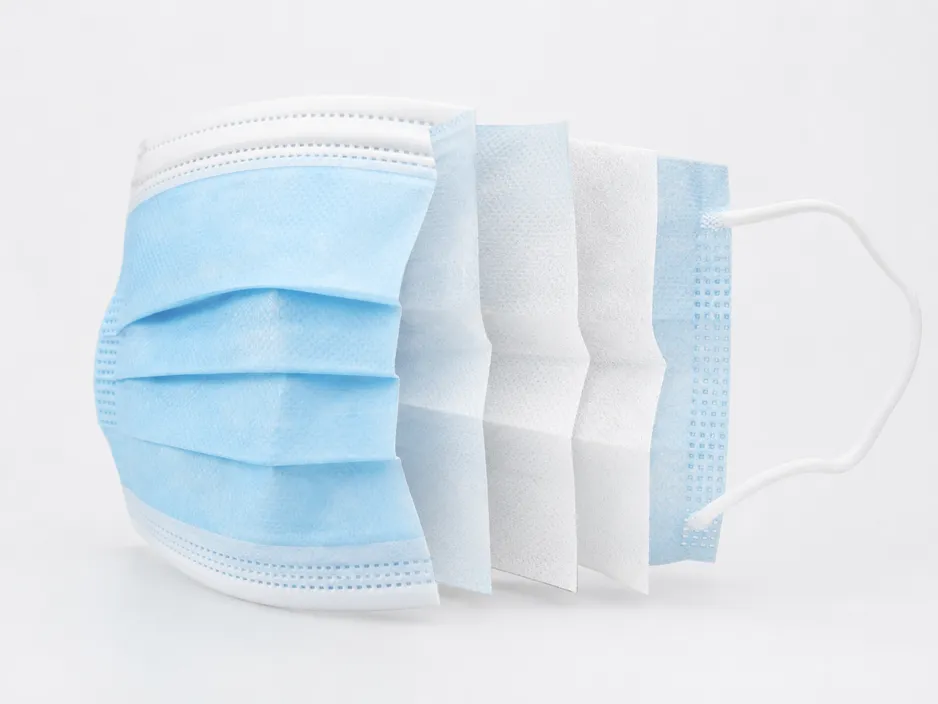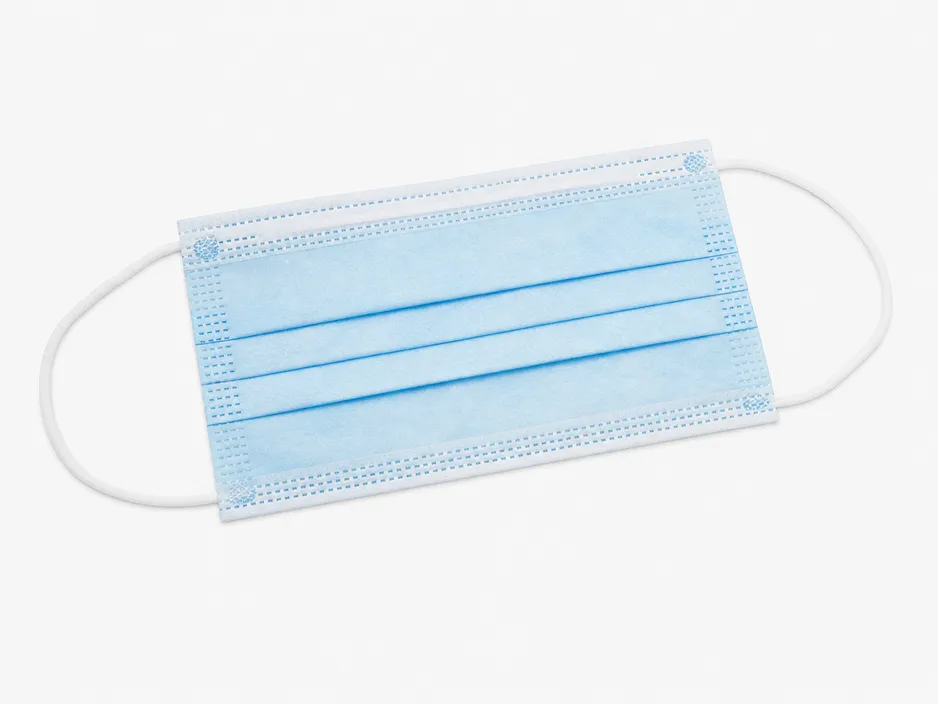
The 4-ply premium is real. Buyers routinely pay 15–25% more per unit for a 4-ply mask over a comparable 3-ply, on the assumption that the extra layer means better filtration. In most cases, it doesn't.
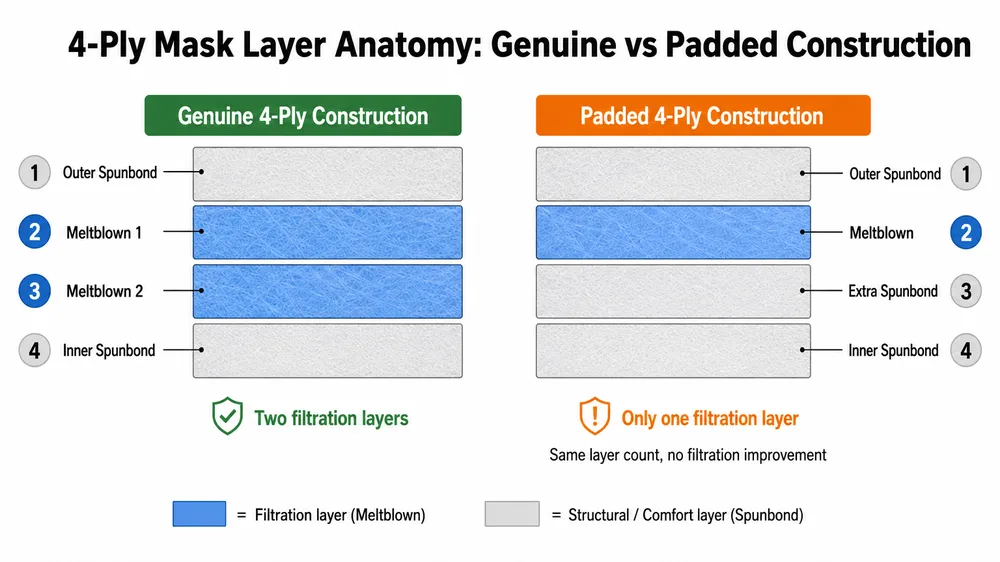
The problem is structural. A genuine 4-ply mask adds a second meltblown layer — the only layer that actually filters. A padded 4-ply mask adds a second spunbond layer — the soft nonwoven that provides comfort and structural shape, but contributes nothing to BFE or PFE performance. Both products are sold as "4-ply." Both may carry the same BFE ≥95% claim on the spec sheet. The difference is that one earns the number and one borrows it from a certification sample that may not represent your production batch.
We've been making 4 Ply Disposable Medical Masks since before the category had a name. What follows is how we'd tell a buyer to evaluate any supplier — including us.

The sourcing trap: why layer count is not a filtration spec
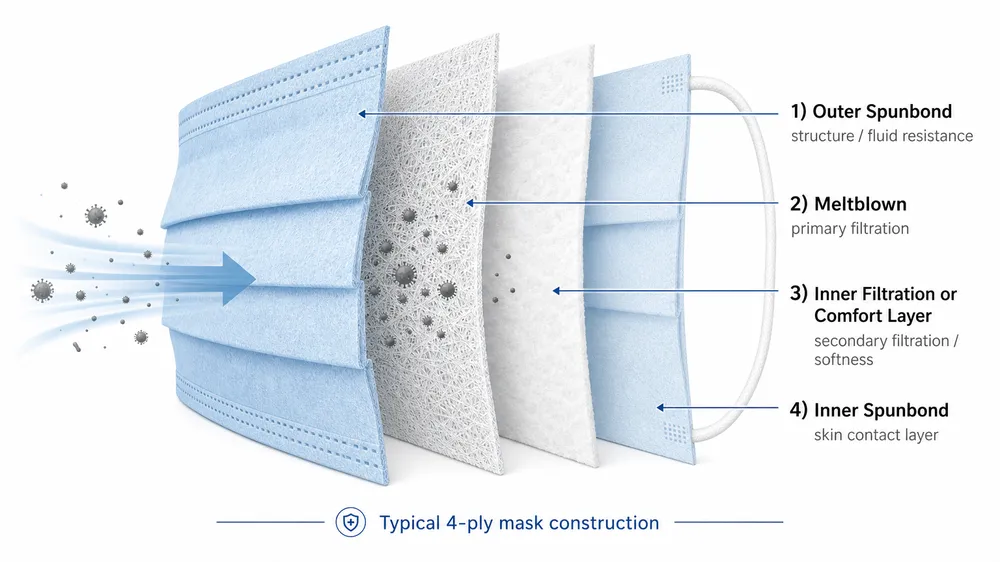
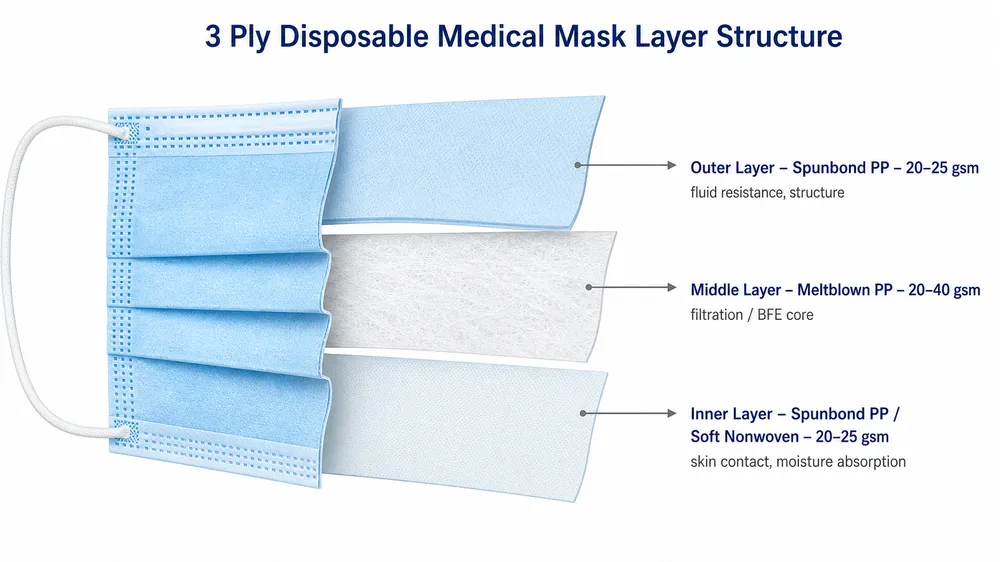
Meltblown nonwoven fabric is the filtration layer in any disposable medical mask. It's produced by extruding polymer through fine nozzles at high velocity, creating a web of microfibers with diameters typically in the 1–5 micron range. The electrostatic charge applied during production is what captures sub-micron particles — bacteria, aerosols, and particulates that would pass straight through spunbond fabric regardless of how many layers you stack.
Spunbond layers — the outer and inner faces of a standard 3-ply mask — are structural. They hold the mask shape, protect the meltblown core from abrasion, and provide the soft surface that contacts skin. They do not filter. Adding a second spunbond layer between the meltblown and the inner face gives you a slightly softer mask. It does not give you a higher BFE.
The reason this matters commercially: if you're sourcing for hospital distribution, institutional procurement, or a private-label healthcare brand, your downstream buyers are specifying filtration performance. A mask that claims ≥95% BFE but achieves it with a single meltblown layer is not a worse product than a genuine dual-meltblown 4-ply — it's a different product. The problem is when you pay for the second meltblown and receive a second spunbond instead.
(We've seen this play out in audit situations. A buyer sources "4-ply" masks for a hospital tender, the procurement team runs their own BFE test on arrival, and the result comes back at 95.2% — technically passing, but identical to the 3-ply product from the same factory. The buyer paid the 4-ply premium for nothing verifiable.)
Layer anatomy: what genuine 4-ply construction actually contains
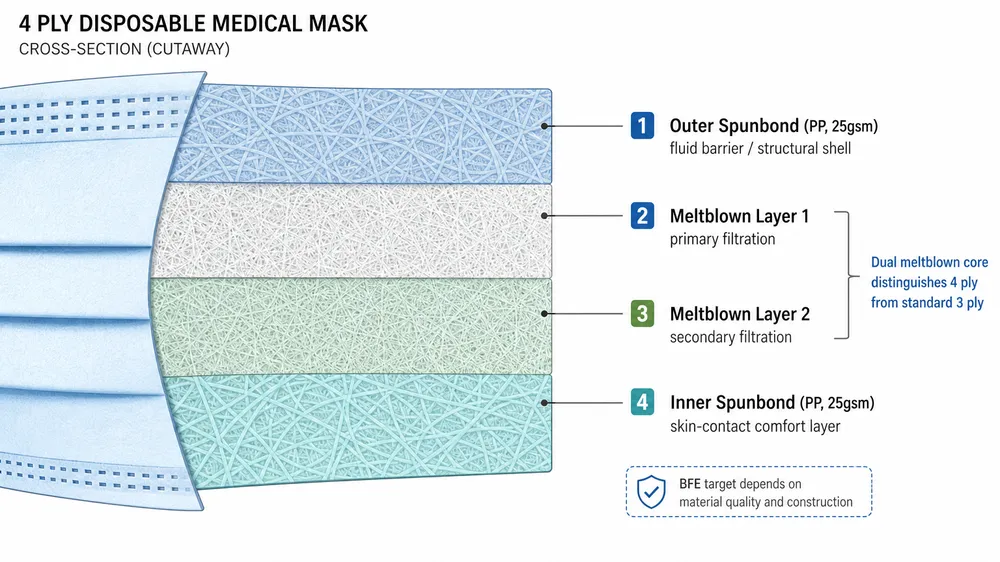
A genuine 4-ply disposable medical mask has this structure, from outside to inside:
| Layer | Material | Function |
|---|---|---|
| Layer 1 (outer) | Spunbond nonwoven | Structural, fluid-resistant outer face |
| Layer 2 | Meltblown nonwoven | Primary filtration — BFE/PFE performance |
| Layer 3 | Meltblown nonwoven | Secondary filtration — incremental BFE/PFE improvement |
| Layer 4 (inner) | Spunbond nonwoven | Soft inner face, skin contact |
The padded variant replaces Layer 3 with a second spunbond layer. From the outside, the masks look identical. The layer count is the same. The weight may be similar. The only way to distinguish them is to ask for the material specification sheet, request the meltblown basis weight for each layer, or run your own BFE test on a production sample — not just the certification sample.
The incremental filtration gain from a genuine dual-meltblown construction is real but modest. A well-made single-meltblown mask can achieve ≥98% BFE. A dual-meltblown construction typically pushes BFE to ≥99% and provides more consistent performance across the batch, because two filtration layers create redundancy against localized fabric defects. The commercial case for genuine 4-ply is consistency and margin on premium SKUs — not a dramatic performance jump.
Step 1: Define your filtration spec before contacting suppliers
The most common sourcing mistake is starting with "I need 4-ply masks" rather than "I need masks that meet ASTM F2100 Level 2." Layer count is a construction descriptor. Performance standards are what your buyers, regulators, and procurement auditors actually care about.
The two frameworks you'll encounter:
ASTM F2100 (US market, FDA-regulated):
- Level 1: BFE ≥95%, PFE ≥95%, Delta-P ≤4.0 mm H₂O/cm²
- Level 2: BFE ≥98%, PFE ≥98%, Delta-P ≤5.0 mm H₂O/cm²
- Level 3: BFE ≥98%, PFE ≥98%, Delta-P ≤5.0 mm H₂O/cm² (plus higher fluid resistance)
EN 14683 (EU market, CE-regulated):
- Type I: BFE ≥95%
- Type II: BFE ≥98%
- Type IIR: BFE ≥98% plus splash resistance (≥120 mmHg)
A genuine 4-ply dual-meltblown mask is typically positioned at ASTM F2100 Level 2 or EN 14683 Type II/IIR. If a supplier quotes you a 4-ply mask at Level 1 / Type I performance, ask why — either the meltblown spec is conservative, or the second layer isn't meltblown.
Before you send a single RFQ, decide:
- Which standard applies to your destination market?
- What performance tier do your downstream buyers require?
- Do you need fluid resistance (ASTM Level 3 or EN Type IIR)?
- Does your buyer's procurement spec reference a specific standard by name?
Getting this right before the RFQ stage saves you from comparing quotes that aren't actually comparable.
Step 2: Request batch-level test reports, not just certification documents
Certification documents — ISO 13485, CE, FDA 510(k) — tell you the supplier's quality management system has been audited. They do not tell you whether the mask in your order performs to spec.
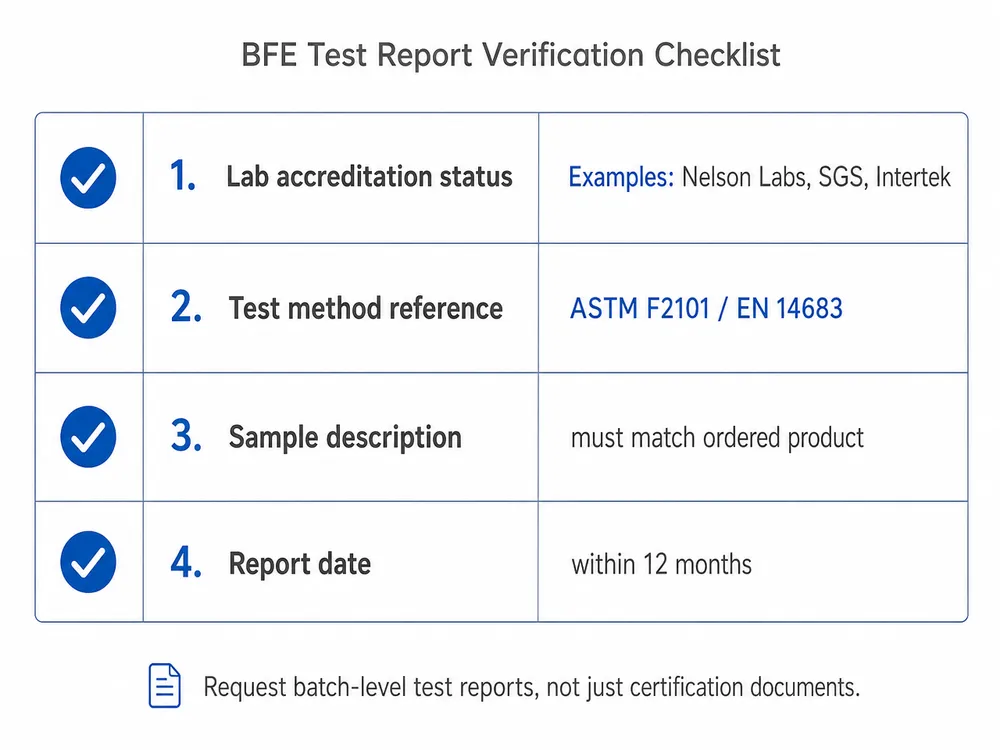
The document that matters for filtration verification is the batch test report: a BFE/PFE/Delta-P test run on a production sample from the specific lot you're buying, or from a recent production run of the same SKU.
What to request:
- Third-party BFE test report — issued by an accredited lab (Nelson Labs, SGS, Intertek, or equivalent), showing the test method (ASTM F2101 for BFE, ASTM F2299 for PFE), the result, and the sample description. The sample description should match the product you're ordering.
- Delta-P test report — breathability is the performance parameter that gets ignored until a hospital procurement team rejects your product. Request it alongside BFE/PFE.
- Meltblown material specification — basis weight (g/m²) and layer count for the meltblown component. A supplier running genuine dual-meltblown construction can tell you the basis weight of each meltblown layer. If they can only give you a combined weight, ask why.
- In-house batch test records — if the supplier runs in-house BFE testing, ask for the internal test log from recent production batches. Consistent in-house results across multiple batches are a stronger signal than a single third-party certification sample.
The red flag to watch for: a supplier who can produce a certification document but cannot produce a batch test report from the last 90 days of production. Certification samples are often run under controlled conditions on purpose-built test masks. Production batches are not.
Step 3: Ask whether the supplier manufactures meltblown in-house
This is the single most important qualification question for 4-ply mask sourcing, and most buyers never ask it.
Meltblown nonwoven fabric is not a commodity. The fiber diameter, basis weight, and electrostatic charge level all affect filtration performance. A supplier who buys meltblown from an external fabric mill is dependent on that mill's consistency — and during periods of supply disruption or high demand, meltblown quality from spot-market suppliers varies significantly. We've seen competitors ship masks that passed BFE testing on the certification sample and failed on production batches because the meltblown roll they used for production came from a different supplier than the one used for the test.
A supplier who manufactures meltblown in-house controls the one variable that determines whether your 4-ply mask actually outperforms a 3-ply. They can tell you the basis weight of each meltblown layer, the fiber diameter range they target, and the electrostatic treatment process. If they can't answer those questions, they're not making the meltblown — they're buying it.
We produce our own meltblown at our Gaomi facility. That's not a marketing claim — it's the reason we can guarantee BFE spec consistency across a 5-million-piece order, not just across the 10-mask certification sample. When you order a mask rated at ≥98% BFE from us, we set the meltblown parameters to hit that number, and we test every production batch against it before the masks leave the line.
Questions to ask any supplier:
- Do you manufacture meltblown nonwoven fabric in-house, or do you source it from a fabric supplier?
- If in-house: what is the basis weight of each meltblown layer in your 4-ply construction?
- If sourced: who is your meltblown supplier, and do you have incoming inspection records for meltblown lots?
- How do you handle a production batch where in-house BFE testing falls below spec?
A supplier who sources meltblown externally isn't automatically disqualified — but they need to show you incoming inspection records and a clear process for handling out-of-spec material. If they can't, your filtration consistency depends on their fabric supplier's quality control, not theirs.
Step 4: Verify cleanroom and QC infrastructure
For medical device procurement — hospital supply chains, institutional tenders, FDA-regulated imports — the manufacturing environment is part of the product specification. A mask produced in an uncontrolled environment can carry particulate contamination that affects both product safety and regulatory compliance.
The relevant standard is ISO 14644-1 cleanroom classification. For disposable medical mask production, Class 100,000 (ISO 8) is the standard that aligns with medical device manufacturing requirements. This means particle counts ≤3,520,000 particles/m³ at ≥0.5 micron, with continuous monitoring and controlled access.
What to request from a supplier:
- Cleanroom classification certificate — ISO 14644-1 classification report from a third-party testing body, showing the cleanroom class and the date of the most recent qualification test
- ISO 13485:2016 certificate — the medical device quality management standard that requires documented risk management, design controls, and traceability. ISO 9001 alone is not equivalent.
- In-house QC lab capability — does the supplier run BFE/PFE/Delta-P testing in-house, or do they rely entirely on third-party labs? In-house testing means problems are caught before shipment, not after.
Our production runs in a Class 100,000 (ISO 8) cleanroom with continuous particle monitoring. The ISO 13485:2016 certification covers our full production and QC process. Our in-house lab runs BFE, PFE, and Delta-P on every production batch — the third-party lab reports that travel with your shipment are the confirmation of what we already know from internal testing.
(ISO 13485 surveillance audits happen annually. If a supplier's certificate is more than 18 months old without a renewal date, ask for the current certificate. Lapsed certifications are more common than buyers expect.)
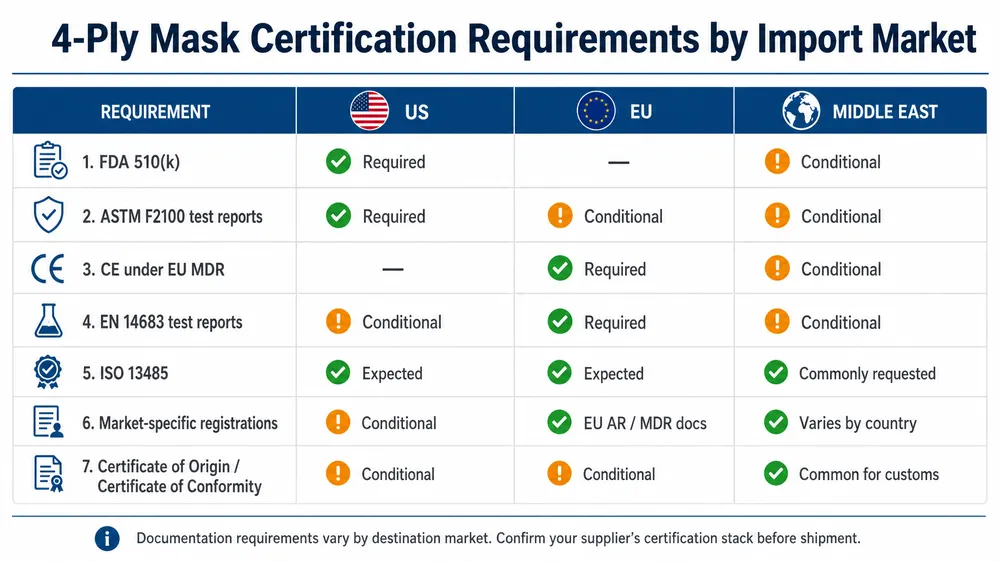
Step 5: Evaluate the documentation package against your import market
The certification stack that matters depends entirely on where you're importing. A supplier with strong CE documentation but no FDA 510(k) registration cannot support a US import without additional compliance work on your end. Get this right before you commit to a supplier.
For US import (FDA-regulated):
- FDA 510(k) registration or FDA Establishment Registration for the manufacturing facility
- ASTM F2100 test reports (BFE, PFE, Delta-P, fluid resistance if Level 3)
- Declaration of Conformity referencing the applicable standard
- Lot traceability documentation
For EU import (CE-regulated under EU MDR):
- CE certificate under EU MDR (Regulation 2017/745) — not the older MDD
- EN 14683 test reports
- Technical file summary available on request
- EU Authorized Representative designation (required for non-EU manufacturers)
For Middle East / Gulf markets:
- SFDA (Saudi) or equivalent national authority registration varies by country
- EN 14683 or ASTM F2100 test reports are typically accepted as supporting documentation
- Certificate of Origin and Certificate of Conformity for customs clearance
Our certification stack — ISO 13485:2016, CE under EU MDR, FDA 510(k), ISO 9001:2015, and SGS — covers the three major import markets. We prepare the full documentation package with every shipment: test reports, certificates of conformity, packing lists, and any market-specific declarations your customs broker needs.
If you're importing into the EU for the first time under MDR, the documentation requirements have caught a lot of buyers off guard since 2021. The EU Authorized Representative requirement alone has delayed shipments for buyers who didn't know it applied to them. We've been through this with multiple European customers and can walk you through what your importer of record will need before you place the order.
Common sourcing mistakes that cost buyers money
These are the patterns we see repeatedly when buyers come to us after a bad sourcing experience:
Accepting BFE claims without requesting the test method. BFE ≥95% tested to ASTM F2101 and BFE ≥95% tested to an unspecified internal method are not the same number. Always ask for the test method reference on the report.
Comparing quotes without aligning specs. A 4-ply mask at $0.08/piece and a 4-ply mask at $0.12/piece may be the same product, or they may be a padded 3-ply and a genuine dual-meltblown. You cannot compare prices without confirming the meltblown layer count and basis weight.
Treating the certification sample as representative of production. Certification samples are often produced under controlled conditions. Request a batch test report from recent production — ideally from a batch produced in the last 60–90 days.
Skipping the meltblown sourcing question. Most buyers ask about certifications and MOQ. Almost none ask whether the supplier makes their own meltblown. This is the question that separates suppliers who control their filtration performance from those who depend on their fabric supplier's consistency.
Ordering without confirming the documentation package for your market. A supplier who cannot provide FDA 510(k) documentation cannot support a US import. Confirming this after you've placed the order is an expensive mistake.
What to include in your RFQ to get comparable quotes
A well-structured RFQ eliminates the ambiguity that makes 4-ply mask quotes incomparable. Include:
- Performance standard and tier: "ASTM F2100 Level 2" or "EN 14683 Type IIR" — not just "4-ply medical mask"
- Meltblown layer count: "Dual-meltblown construction required" — state it explicitly
- BFE/PFE minimum: the specific percentage your downstream buyers require
- Destination market: US, EU, or other — so the supplier knows which certification stack applies
- Order volume and frequency: total pieces per order and expected reorder cadence
- Documentation requirements: list the specific documents you need (batch test reports, certificates, FDA records)
- Packaging requirements: bulk clinical packaging, retail-ready, or private-label — this affects unit cost and lead time
When you send this RFQ to multiple suppliers, you'll get quotes that are actually comparable. More importantly, suppliers who can't meet the spec will self-select out rather than quoting a padded product and hoping you don't notice.
Supplier qualification checklist
Use this before committing to any 4-ply mask supplier:
Construction verification
- [ ] Confirmed dual-meltblown layer construction (not spunbond substitution)
- [ ] Meltblown basis weight per layer provided in writing
- [ ] Material specification sheet available
Filtration documentation
- [ ] Third-party BFE test report from accredited lab (within 12 months)
- [ ] PFE test report available
- [ ] Delta-P test report available
- [ ] Test method reference matches your target standard (ASTM F2101 / EN 14683)
Manufacturing capability
- [ ] In-house meltblown production confirmed (or incoming inspection records for sourced meltblown)
- [ ] Cleanroom classification certificate (ISO 8 / Class 100,000 or equivalent)
- [ ] ISO 13485:2016 certificate current and valid
- [ ] In-house BFE/PFE testing capability confirmed
Market compliance
- [ ] FDA 510(k) registration (US imports)
- [ ] CE certificate under EU MDR (EU imports)
- [ ] Batch test reports available for recent production runs
- [ ] Full export documentation package confirmed
Commercial terms
- [ ] MOQ confirmed against your order volume
- [ ] Lead time confirmed with a specific date, not a range
- [ ] Sample policy confirmed before full order commitment
FAQ
What is the difference between a genuine 4-ply mask and a padded 4-ply mask?
A genuine 4-ply mask uses two meltblown nonwoven layers as the filtration core, sandwiched between two spunbond outer layers. A padded 4-ply mask replaces one of the meltblown layers with a second spunbond layer. The layer count is the same; the filtration performance is not. To confirm which construction you're buying, request the meltblown basis weight for each layer from the supplier's material specification sheet.
Can a single-meltblown mask achieve the same BFE as a dual-meltblown 4-ply?
Yes. A well-made single-meltblown mask can achieve ≥98% BFE. The advantage of dual-meltblown construction is not a dramatically higher peak BFE — it's more consistent performance across the production batch, because two filtration layers provide redundancy against localized fabric defects. For high-volume institutional procurement where batch-to-batch consistency matters, dual-meltblown is the more defensible spec.
What test reports should I request before placing a 4-ply mask order?
At minimum: a third-party BFE test report (ASTM F2101 or EN 14683 method), a PFE test report, and a Delta-P test report, all from an accredited lab and issued within the last 12 months. For US imports, also request FDA 510(k) documentation. For EU imports, request the CE certificate under EU MDR and the EN 14683 test report. Ask for batch test reports from recent production, not just the certification sample.
Does in-house meltblown production actually matter for filtration consistency?
It's the most important variable most buyers don't ask about. A supplier who buys meltblown from an external fabric mill is dependent on that mill's quality control. During high-demand periods or supply disruptions, meltblown quality from spot-market suppliers varies. A supplier who manufactures meltblown in-house controls the fiber diameter, basis weight, and electrostatic charge — the three parameters that determine BFE performance. They can guarantee spec consistency across your entire order, not just the certification sample.
What MOQ is realistic for a first 4-ply mask order?
50,000 pieces is a workable starting point for standard SKUs from a certified manufacturer. Below that, the economics of line setup and documentation preparation don't work well for either side. If you need a smaller quantity to test the market or qualify the product with a downstream buyer, ask about sample orders — most manufacturers will ship a few hundred pieces for evaluation before you commit to a production run.
If you're ready to source 4 Ply Disposable Medical Masks with verified dual-meltblown construction and a full documentation package for your import market, request a quote with your target BFE spec, order volume, destination market, and certification requirements. We'll respond with a product match, the relevant test documentation, and a production timeline.