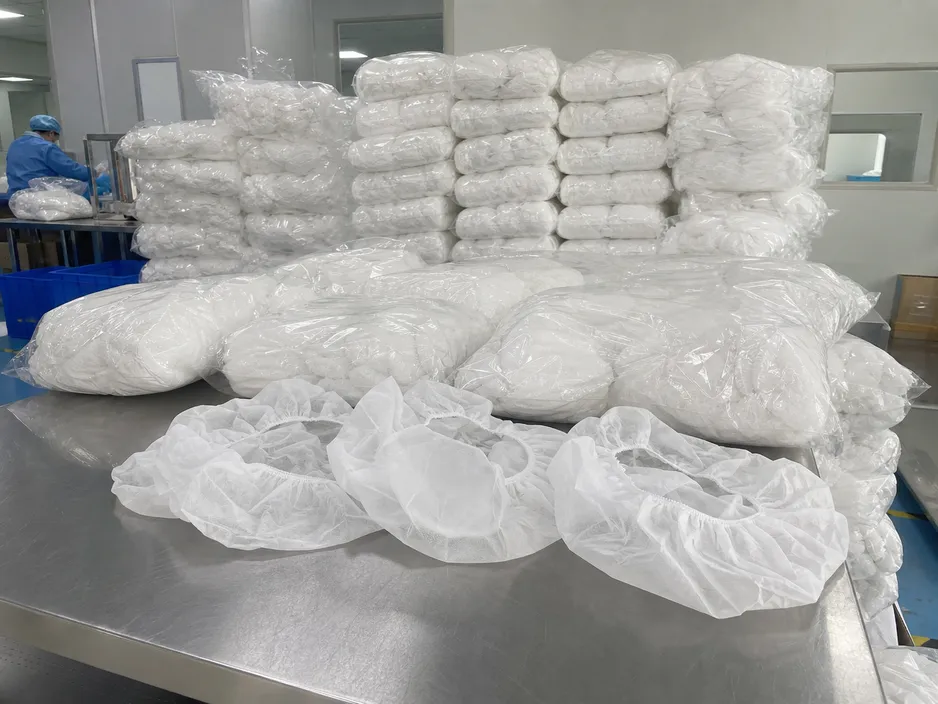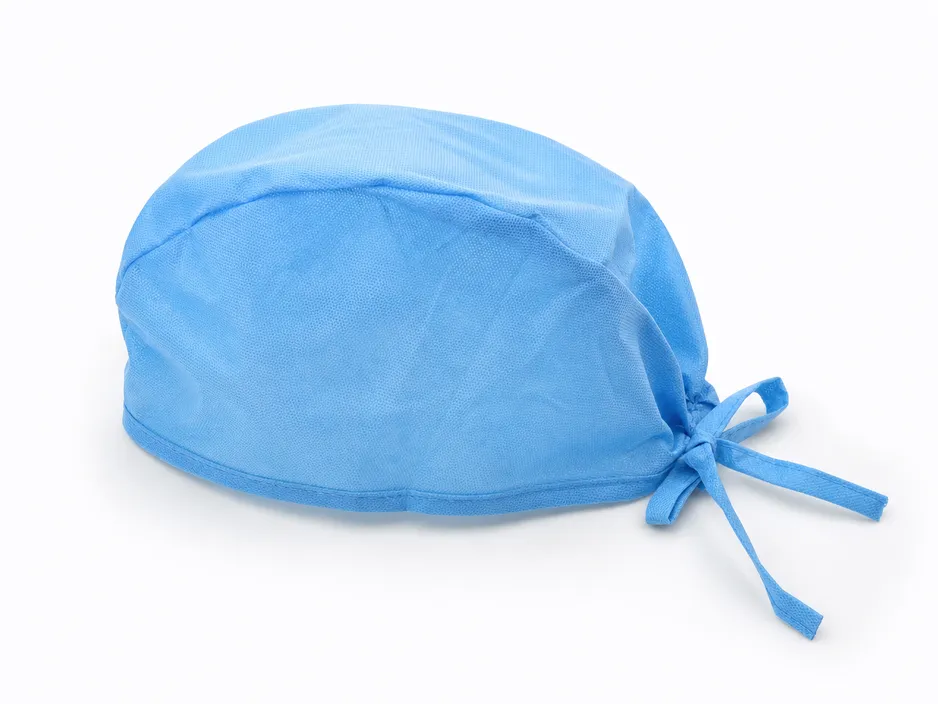
A cap that fails fit at scale isn't a sizing problem. It's a fabric and elastic spec problem caught too late.
That's the reality we see when buyers come to us after a bad batch. The caps looked fine on the sample. The diameter was listed correctly on the spec sheet. But somewhere between the sample approval and the 50,000-unit production run, elastic tension drifted, nonwoven GSM shifted, and the caps that were supposed to fit a 22-inch head circumference started slipping off or cutting into the skin by the end of a four-hour OR shift.
This guide covers the full bouffant medical cap sizing specification — diameter options, head circumference fit ranges, elastic tensile tolerances, and how nonwoven GSM interacts with cap volume. If you're placing a high-volume OR order and need to write a spec that actually holds across batches, this is where to start.

Standard bouffant cap diameter options and the head circumference ranges they cover
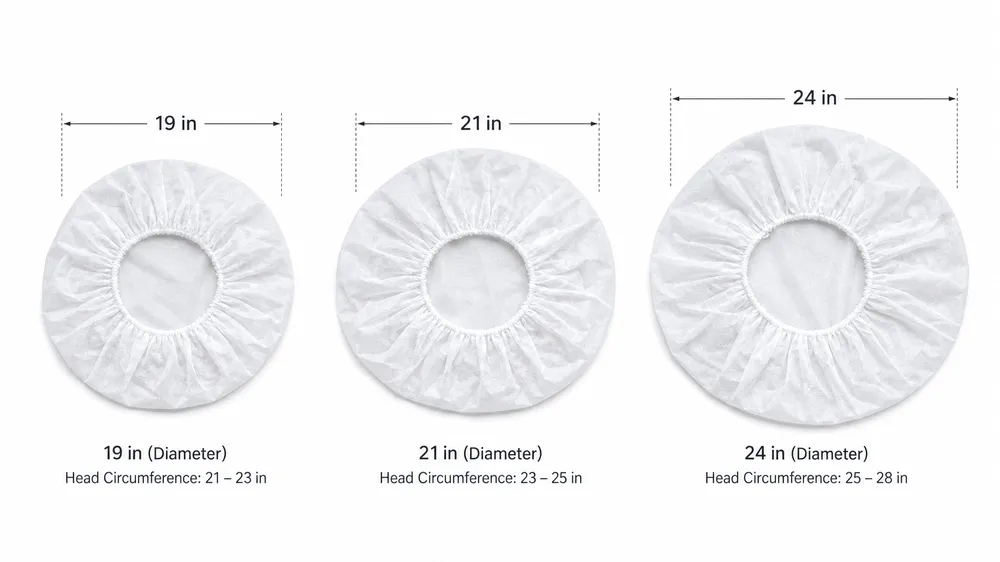
The three standard diameters in the market are 19", 21", and 24". Each maps to a different head circumference range, and choosing the wrong one for your buyer's staff population is the fastest way to generate complaints on the first delivery.
| Cap Diameter | Flat Diameter (approx.) | Recommended Head Circumference | Typical Application |
|---|---|---|---|
| 19" (48 cm) | ~48 cm | 50–54 cm | Pediatric, smaller adult heads |
| 21" (53 cm) | ~53 cm | 54–58 cm | Standard adult, most clinical staff |
| 24" (61 cm) | ~61 cm | 58–64 cm | Larger adult heads, surgical teams with hair volume |
The 21" is the workhorse. Most hospital procurement teams default to it for general clinical staff, and it covers the majority of adult head circumferences without issue. Where buyers get into trouble is when they order a single size for an entire OR department without accounting for the range of head sizes on a surgical team — particularly staff with longer hair or heavier hair volume, where the 21" cap sits too high and loses its seal at the hairline.
The 24" is not just for larger heads. It's also the right call for staff with significant hair volume — braids, natural hair, or longer hair worn up — where the cap needs extra interior volume to contain hair without the elastic pulling the cap down over the forehead. (We've had buyers in the US and UK specifically request the 24" for this reason, and it's worth flagging to your hospital clients before they default to 21" across the board.)
The 19" is a niche size. It shows up in pediatric surgical settings and occasionally in facilities with predominantly smaller-framed staff populations. If your buyer hasn't specifically asked for it, don't assume it's needed — but do confirm before you exclude it from a multi-SKU order.
For a Bouffant Medical Cap order covering a full OR department, the standard approach is to offer 21" as the primary SKU and 24" as a secondary option, with a rough 70/30 or 80/20 split depending on the facility's staff profile. That ratio protects your buyer from running out of the larger size mid-contract.
Elastic specification: tensile strength, elongation, and what failure looks like in production
Elastic spec is where most bouffant cap sourcing goes wrong, and it's the dimension that almost no competitor publishes in any useful detail.
The elastic in a bouffant cap does two jobs: it holds the cap against the head during movement, and it distributes pressure evenly around the circumference so it doesn't cut into the skin during a long procedure. Both functions depend on the elastic's tensile properties staying within a defined range — not just at the time of manufacture, but across every batch in a multi-month supply contract.
The relevant parameters are:
Tensile strength at break: For standard bouffant cap elastic (typically 3–5 mm flat elastic), a working range of 15–25 N is typical for medical-grade applications. Below 15 N, the elastic stretches out under normal use and the cap loses its seal. Above 25 N, the cap becomes uncomfortable for extended wear and can leave pressure marks on the skin.
Elongation at break: Typical range is 400–600%. This determines how much the elastic can stretch before it fails permanently. Elastic that falls below 400% elongation tends to feel stiff and loses recovery after repeated donning and doffing — relevant for staff who put on and remove caps multiple times per shift.
Elastic width: 3 mm and 5 mm are the two standard widths. The 5 mm distributes pressure over a wider contact area, which matters for extended OR use. The 3 mm is lighter and more common in general clinical caps where comfort over a 4-hour procedure isn't the primary concern.
Attachment method: Ultrasonic welding versus sewn attachment. Ultrasonic welding produces a consistent bond strength determined by machine parameters — the attachment force doesn't vary with operator technique. Sewn elastic attachment introduces variability at the seam, and in high-volume production, seam quality is the first thing that drifts when line speed increases.
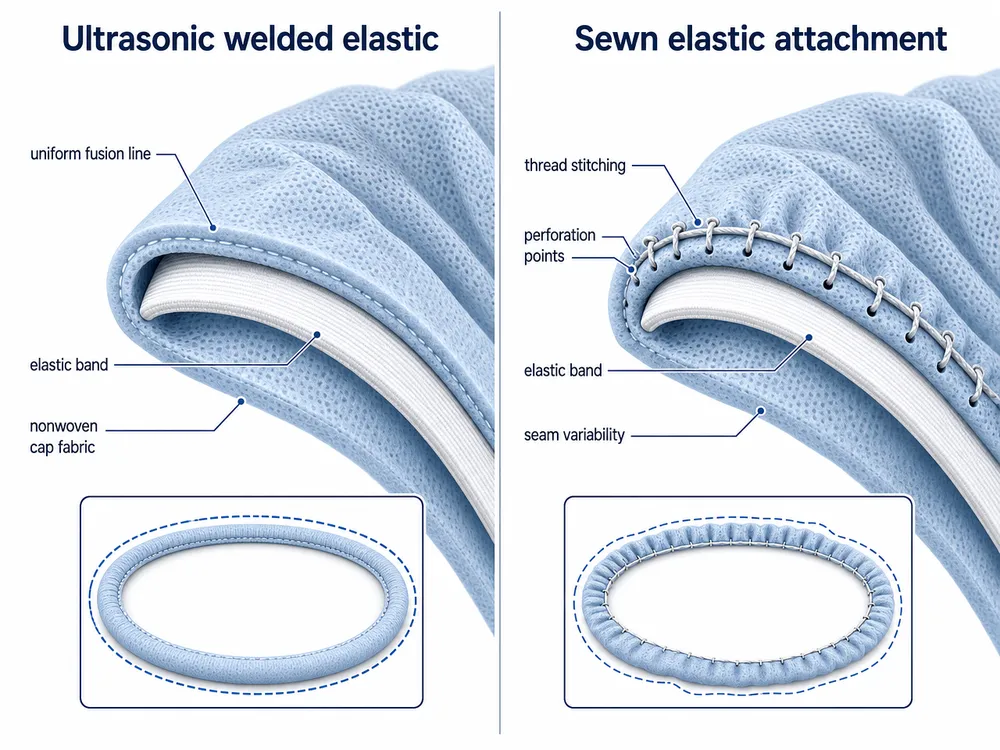
We run ultrasonic welding on our cap lines for the same reason we use it on our mask ear-loop attachment: the bond strength is a machine parameter, not a craftsmanship variable. At 50,000 units, the difference between a consistent weld and a variable seam shows up in your return rate.
What elastic spec drift looks like at scale
Spec drift is the failure mode that doesn't show up in samples. A sample batch of 100 caps will pass any reasonable fit test. The problem emerges at 10,000 units when the elastic supplier ships a roll with slightly different tensile properties, or at 30,000 units when the production line speed is increased and the ultrasonic weld dwell time shortens by 0.2 seconds.
The symptoms your buyer will report: caps that feel looser than the original samples, caps that slip during procedures, or — on the other end — caps that leave red marks on the forehead after a two-hour surgery. All three are elastic spec problems, not sizing problems. But by the time the complaint reaches you, the batch has shipped and the conversation is about returns, not root cause.
The fix is to write elastic tensile spec into the purchase order, not just cap diameter. Specifically: tensile strength range (e.g., 18–22 N), elongation at break minimum (e.g., ≥450%), and attachment method. A factory that can't provide incoming inspection records for elastic tensile properties is a factory that can't guarantee spec consistency across batches.
How nonwoven GSM affects cap volume, hair containment, and fit consistency
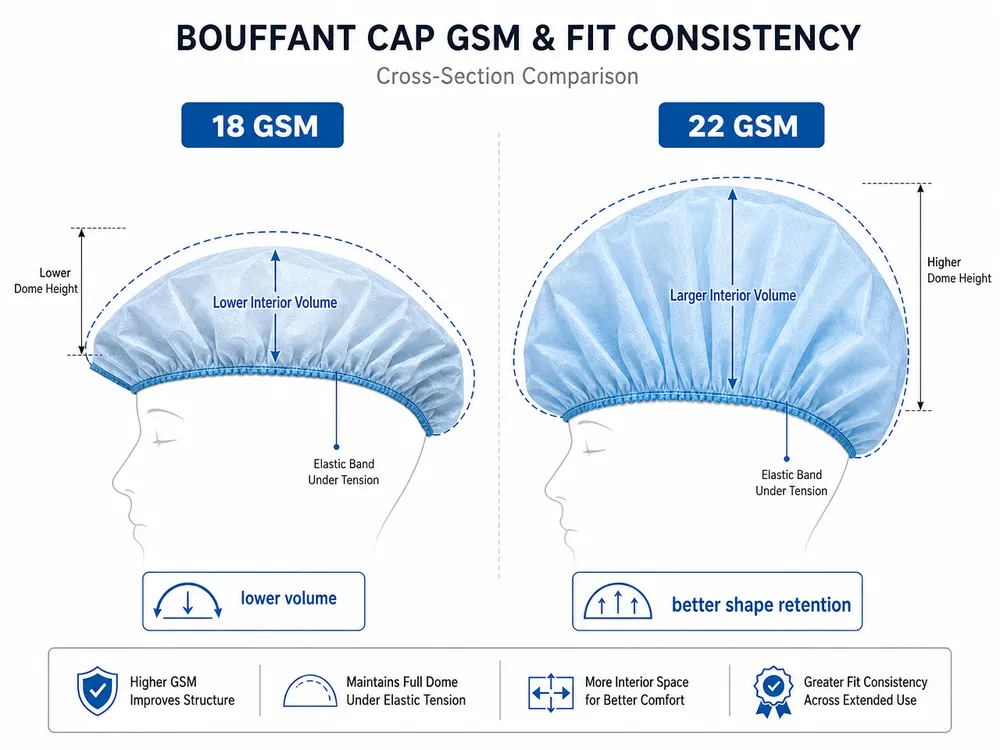
The nonwoven fabric weight — measured in grams per square meter (GSM) — determines how the cap holds its shape, how much interior volume it provides, and how consistently it performs across a production lot.
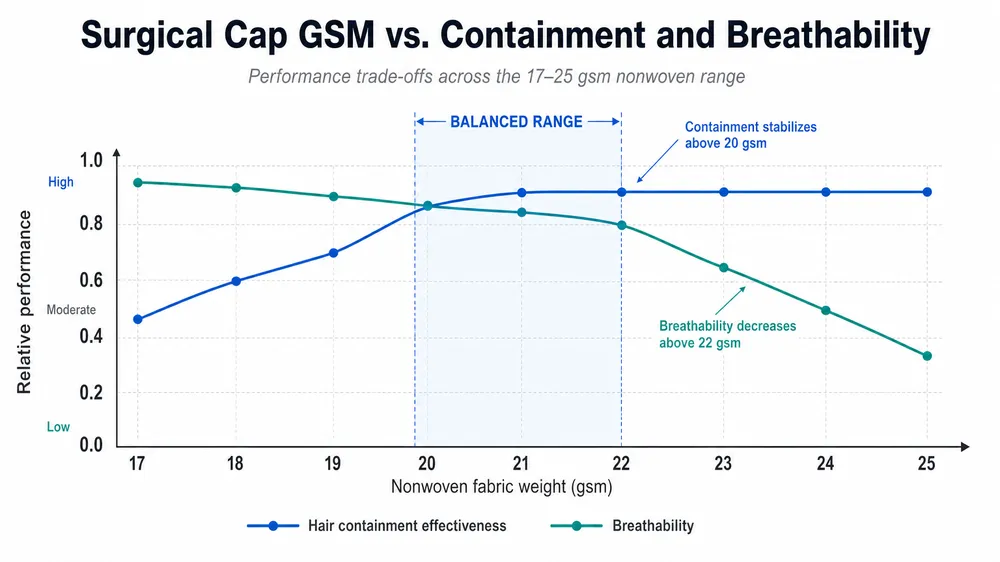
Standard bouffant caps run in the 17–25 GSM range for the nonwoven spunbond fabric. The practical implications:
| GSM Range | Cap Behavior | Best Application |
|---|---|---|
| 17–19 GSM | Lightweight, drapes easily, lower volume | General clinical use, short procedures |
| 20–22 GSM | Balanced structure and volume | Standard OR use, most hospital procurement |
| 23–25 GSM | Stiffer, higher volume, better hair containment | Surgical teams, high hair volume, extended procedures |
Lower GSM caps are cheaper and lighter, but they collapse more easily under the elastic tension, which reduces interior volume and makes hair containment less reliable for staff with longer or thicker hair. Higher GSM caps hold their dome shape better, which is what you want in an OR environment where the cap needs to stay in position through a two-to-four-hour procedure.
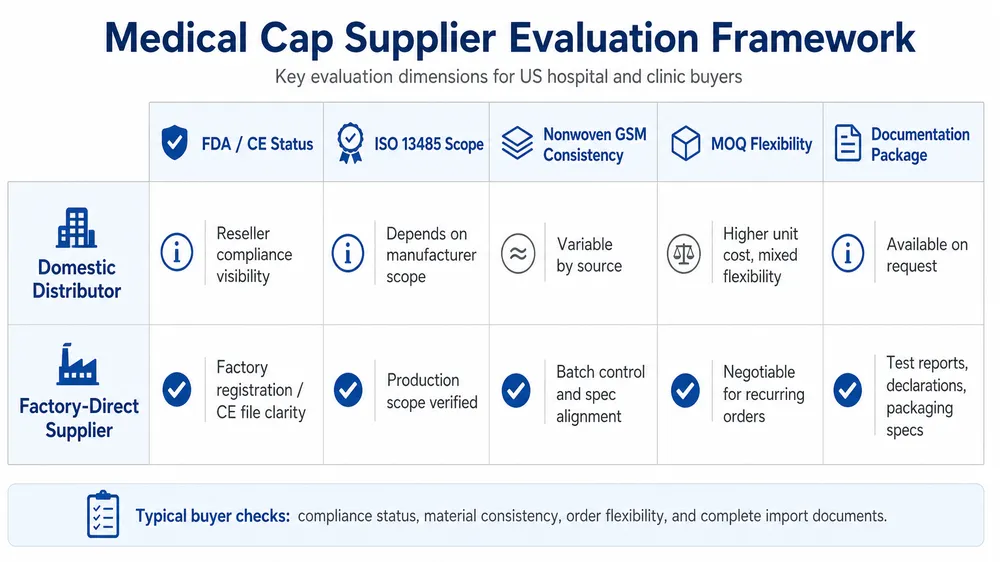
The sourcing risk here is GSM variation between lots. A factory buying nonwoven fabric from outside suppliers has limited control over lot-to-lot GSM consistency. We produce our own nonwoven spunbond fabric in-house, which means the GSM spec is set at our production line, not at a supplier's warehouse. When your buyer orders 20 GSM caps, every cap in every batch is 20 GSM — not 18 GSM from one lot and 22 GSM from the next.
(GSM variation of ±2 g/m² sounds minor on paper. In practice, it changes the cap's interior volume enough that staff notice the difference between batches. We've had buyers come to us specifically because their previous supplier's caps "felt different" from order to order — and the root cause was always GSM drift.)
For Medical Caps procurement at hospital scale, specifying GSM in the PO is as important as specifying diameter. If your current supplier's spec sheet only lists "nonwoven bouffant cap" without a GSM value, that's a gap worth closing before your next order.
Spec drift in bulk orders: why tolerances must be written into the PO
The single most common sourcing mistake in high-volume bouffant cap procurement is treating the sample as the spec. The sample is a snapshot. The PO is the contract. If the PO doesn't define tolerances, the factory has no obligation to hold them.
Here's what needs to be written into the PO for a high-volume OR order:
Cap diameter tolerance: ±5 mm on the flat diameter is a reasonable working tolerance. Beyond that, you're looking at fit variation that staff will notice. A 21" cap that ships at 19.5" flat diameter is effectively a different product.
Elastic tensile strength range: State the minimum and maximum in Newtons. A range of ±3–4 N around your target value is workable. Wider than that and you're accepting the full spectrum of "feels tight" to "falls off."
Elastic elongation at break minimum: State a floor value. 400% is a reasonable minimum for medical-grade elastic in this application.
Nonwoven GSM with tolerance: ±1 g/m² is tight but achievable with in-house nonwoven production. ±2 g/m² is the practical limit for factories buying fabric externally.
Attachment method: Specify ultrasonic welding if that's what you approved in the sample. Don't leave it open to substitution.
Batch documentation requirements: Specify that each production batch must be accompanied by incoming inspection records for elastic tensile properties and nonwoven GSM, plus dimensional inspection records for cap diameter. This is the documentation that lets you audit compliance without waiting for a complaint.
Our ISO 13485 QC process covers all of these parameters — cap dimensions, elastic attachment integrity, and nonwoven GSM are part of our in-process and outgoing inspection protocol, not just mask production. That's verifiable at audit, and we provide the documentation with every shipment.
If you're comparing suppliers and want to understand how their QC process handles these parameters, the right question to ask is: "Can you show me your incoming inspection records for elastic tensile properties from your last three production batches?" A factory that can answer that question with actual records is a factory that controls its spec. A factory that can't is a factory that's hoping the elastic supplier shipped the right roll.
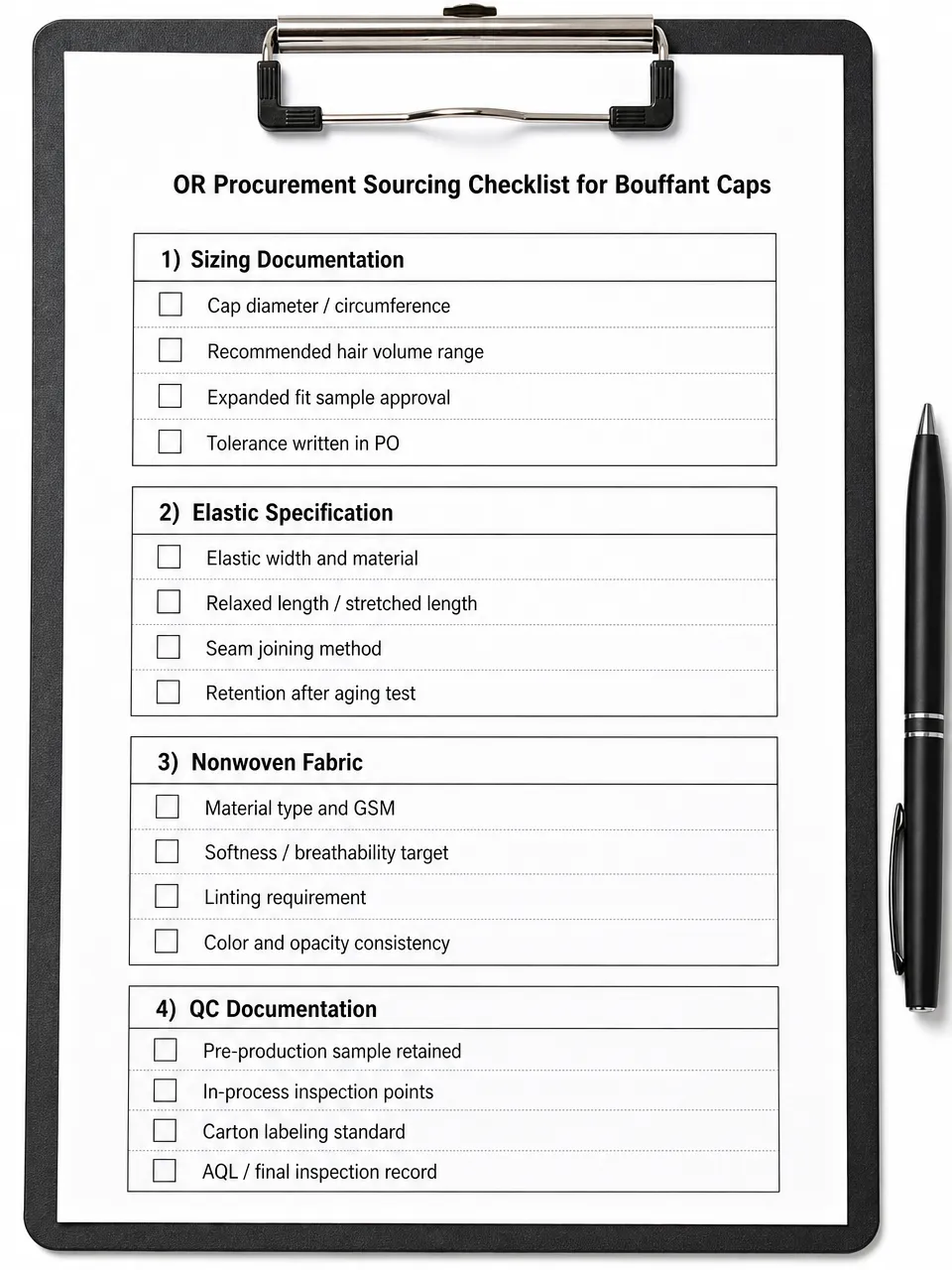
Sourcing checklist for OR procurement teams placing high-volume orders
Before committing to volume, verify these parameters with any supplier:
Sizing documentation
- [ ] Flat diameter spec for each size option (19", 21", 24") with stated tolerance
- [ ] Head circumference fit range mapped to each diameter
- [ ] Sample caps in each size for physical fit testing before PO
Elastic specification
- [ ] Elastic width (3 mm or 5 mm) confirmed
- [ ] Tensile strength at break range (in Newtons) — ask for the spec, not just "medical grade"
- [ ] Elongation at break minimum confirmed
- [ ] Attachment method confirmed (ultrasonic weld preferred for consistency)
- [ ] Incoming inspection records for elastic tensile properties available on request
Nonwoven fabric
- [ ] GSM value stated with tolerance (not just "nonwoven" or "spunbond")
- [ ] Fabric sourcing confirmed (in-house production vs. external supplier)
- [ ] Lot-to-lot GSM consistency records available
QC documentation
- [ ] ISO 13485 certification covering cap production (not just masks)
- [ ] Dimensional inspection records per production batch
- [ ] Elastic attachment integrity testing records
- [ ] Batch traceability documentation
Order structure
- [ ] Size split confirmed (recommend 21" primary, 24" secondary for OR departments)
- [ ] Sample batch approved before full production release
- [ ] Spec parameters written into PO, not just referenced from sample
Diameter, elastic, and GSM: the three-parameter spec that holds across batches
Most bouffant cap spec failures trace back to the same gap: the buyer specified diameter and nothing else. Diameter tells you the cap will fit on the head. Elastic tensile spec tells you it will stay there. Nonwoven GSM tells you it will contain hair through a full procedure. All three need to be in the PO.
The 21" diameter covers the majority of OR staff. The 24" covers staff with higher hair volume and should be included in any multi-SKU order for a surgical department. Elastic tensile strength in the 18–22 N range with ≥450% elongation at break is a workable spec for extended OR use. Nonwoven GSM in the 20–22 range gives you the balance of structure and volume that holds up through a four-hour procedure.
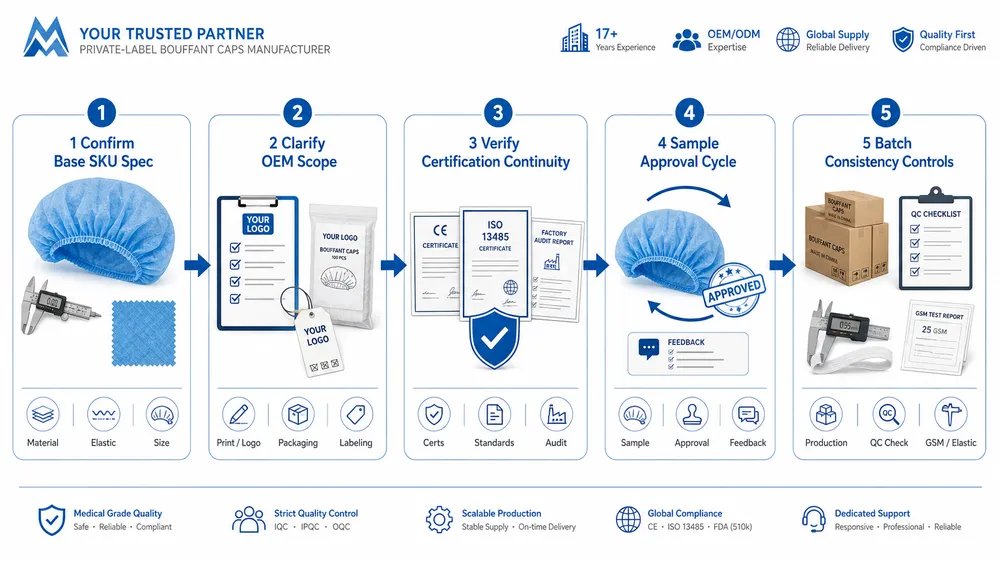
For buyers placing volume orders across multiple facilities or building a private-label cap program, the additional question is whether your supplier can hold these specs across batches — not just in the first production run. That requires in-house nonwoven production, documented elastic incoming inspection, and an ISO 13485 QC process that covers cap dimensions and elastic attachment. We can provide all three, with documentation.
If you're ready to define your spec and want a sample batch for fit verification before committing to volume, send us an RFQ with your required diameter, elastic spec, and monthly volume. We'll confirm dimensional tolerances and ship a sample batch before full production starts.
For a broader look at cap type selection — including when a surgical cap is the right choice over a bouffant — see our guide on bouffant cap vs surgical cap.
Frequently asked questions
What is the standard bouffant cap size for an operating room?
The 21" (53 cm flat diameter) is the standard for most OR environments, covering head circumferences from approximately 54–58 cm. For surgical teams with staff who have significant hair volume, the 24" (61 cm) should be included as a secondary SKU. Ordering only one size for a full OR department is the most common cause of fit complaints on the first delivery.
How do I specify elastic tension for a bouffant cap PO?
State tensile strength at break in Newtons (a working range of 18–22 N is appropriate for extended OR use) and elongation at break minimum (≥450% is a reasonable floor for medical-grade elastic). Also specify attachment method — ultrasonic welding produces more consistent bond strength than sewn attachment at high production volumes. If your current spec sheet only says "elastic" without tensile values, you have no enforceable standard.
What GSM nonwoven fabric should I specify for OR bouffant caps?
20–22 GSM is the standard range for OR use. It provides enough structural rigidity to maintain dome shape under elastic tension while keeping the cap lightweight for extended wear. Below 18 GSM, the cap collapses more easily and hair containment becomes less reliable. Above 24 GSM, the cap becomes stiffer and less comfortable for long procedures.
Why do bouffant caps from the same supplier feel different between orders?
Lot-to-lot variation in elastic tensile properties and nonwoven GSM is the most common cause. If the supplier buys elastic and nonwoven fabric from external sources, they have limited control over incoming material consistency. Ask for incoming inspection records for elastic tensile properties and nonwoven GSM from the last three production batches — if those records don't exist, the supplier isn't controlling the spec.
What is the minimum documentation I should require for a high-volume OR cap order?
At minimum: dimensional inspection records per production batch (cap diameter with tolerance), incoming inspection records for elastic tensile properties, nonwoven GSM batch records, and a certificate of conformity. If the supplier holds ISO 13485 certification covering cap production, those records should be part of their standard QC output. If they can't produce them on request, the certification isn't covering what you think it is.
What MOQ is typical for bouffant caps with a custom elastic spec?
Standard SKUs (21" or 24" in standard GSM and elastic configurations) typically start at 50,000 pieces. Custom elastic specifications or non-standard GSM values may require higher minimums to justify material procurement and line setup. Confirm this before approving samples — the sample approval process and the MOQ conversation should happen at the same time, not after.